I want to play mind games with you. In my last blog post, I shared how to plan an agenda for your brainstorming session. I mentioned that I’m not a big fan of traditional ice breakers – they work fine, but they feel too much like forced socialization rather than a way to prepare your brain for creativity. In this article, I’m going to show you how I loosen teams up and get them thinking with mind games.
Loosen Up by Stretching
The goal is to stretch your imagination. It’s just like stretching before you go for a run (which is also a great thing to do while preparing for brainstorming). We want to disrupt routine thought patterns, and push past the initial “easy” ideas to look for that unique approach and competitive advantage. These mind exercises help people realize that even things that seem impossible can have solutions (even simple solutions). These are NOT a test, it’s OK to not understand, and people should feel welcome to throw out wild or goofy suggestions.
In the rest of this article, I’m going to share several types of mind games: optical illusions, brain teasers, riddles, jokes, and team activities. I’ll share enough that you can run several brainstorming sessions for the same team without reusing them. So pick the ones you like and get to stretching!
Don’t Spoil It!
When you run these in a live brainstorming session, make sure to tell your attendees not to spoil it if they’ve seen one before. Let people have time to think about it and enjoy them. Consider offering to let people leave the room when you reveal the answers.
NOTE: To allow you to read this article without spoiling any of the brain teasers, I have set it up to click to view hints and answers. |
Optical Illusions
Here are six optical illusions that I love. It shows your attendees that things are not always what they first appear, and that our brains can play tricks on us.
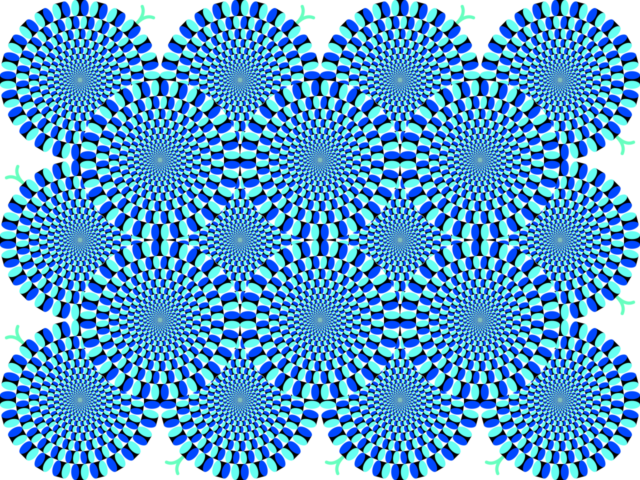
Optical Illusion #1 – Peripheral Drift Rotating Snakes
This is a static image, but as you look around the image it appears to move with rotating circles. (Wikimedia Commons)
Optical Illusion #2 – Double-Image
There is more than one picture in this image. (Wikimedia Commons)

Reveal AnswerCan you see the duck? How about the rabbit? 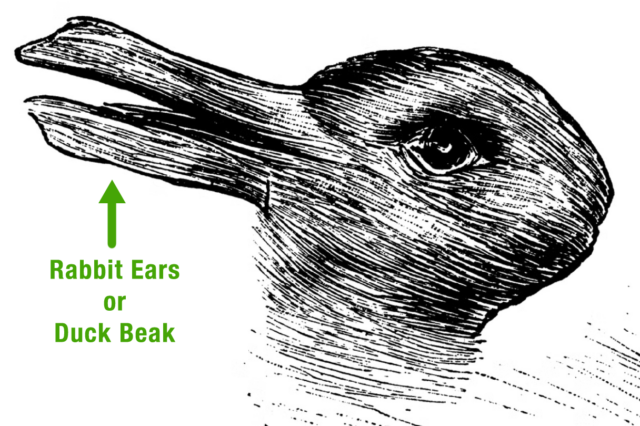 |
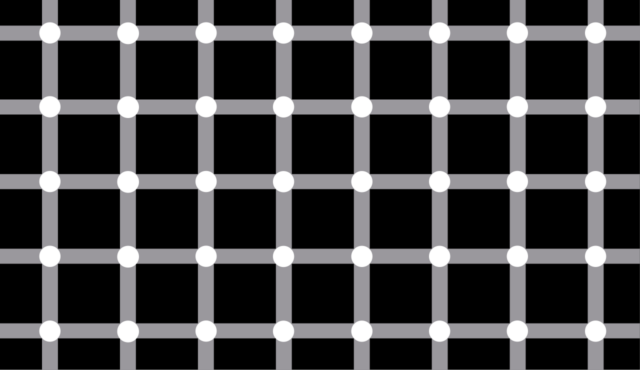
Optical Illusion #3 – Scintillating Grid
Staring at this will cause the white circles to appear like black dots around the edges of your focus. (Wikimedia Commons)
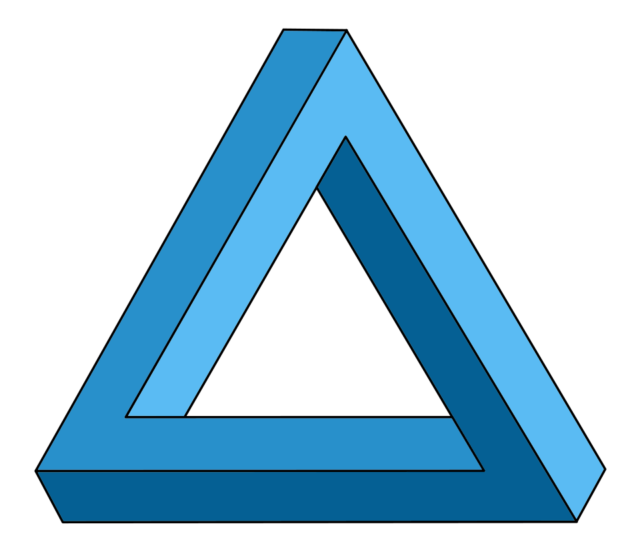
Optical Illusion #4 – Penrose Triangle
This illusion works because a 2D drawing can appear to be 3D but achieve effects that cannot be done in 3D. This shape cannot exist in 3D space. (Wikimedia Commons)
Optical Illusion #5 – Ebbinghause Illusion
Each set of circles has a center circle. Which center circle is the largest? (Wikimedia Commons)

Reveal AnswerThey are exactly the same size. The sizes of the shapes that surround the center circle changes our perception. 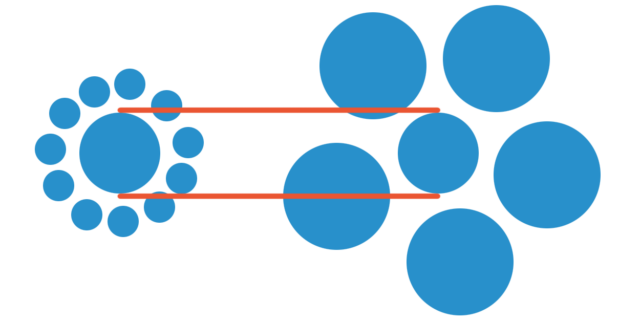 |
Optical Illusion #6 – Troxler Effect
Stare at the red dot for up to 20 seconds and the blue circle will disappear. (Wikimedia Commons)

Brain Teasers
Next, try these six brain teasers that will stump and entertain your crew. These help teams realize that problems are difficult, but that doesn’t mean they can’t be solved.
Brain Teaser #1 – Cross the Moat
A treasure sits in the middle of a perfectly square island surrounded by a moat 10 feet wide and too deep and treacherous to cross. You need to get across the moat without jumping, climbing, or swimming. There are two sturdy planks 10 feet in length and 3 feet wide. There is nothing to bind the planks together and nothing to cut them with. How can you use the planks to walk safely over the moat?
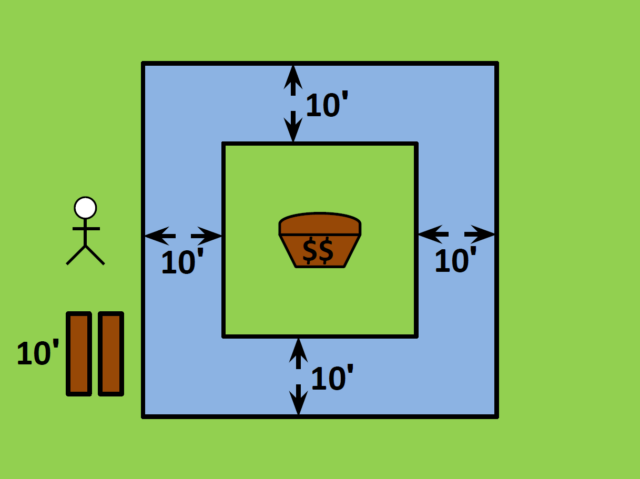
Get a HintThe planks do not need to be longer. Instead consider ways to overlap the two planks. |
Reveal AnswerCreate a “T” shape at the corner of the moat, then go retrieve your treasure! 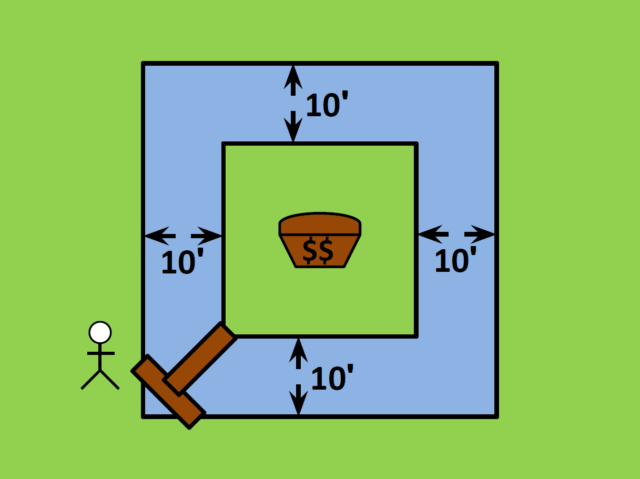 |
Brain Teaser #2 – Confusing Math
Can you explain this odd and unexpected problem?
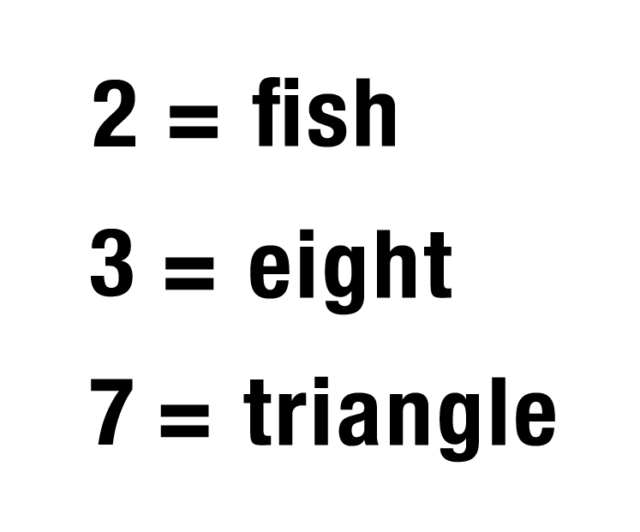
Get a HintThis isn’t math. How can you use the number 2 to end up with a fish? Or the number 3 to arrive at an eight? |
Reveal AnswerDuplicate the shape of each number, then position, rotate, and/or mirror the shape of the original number to create the word on the right. 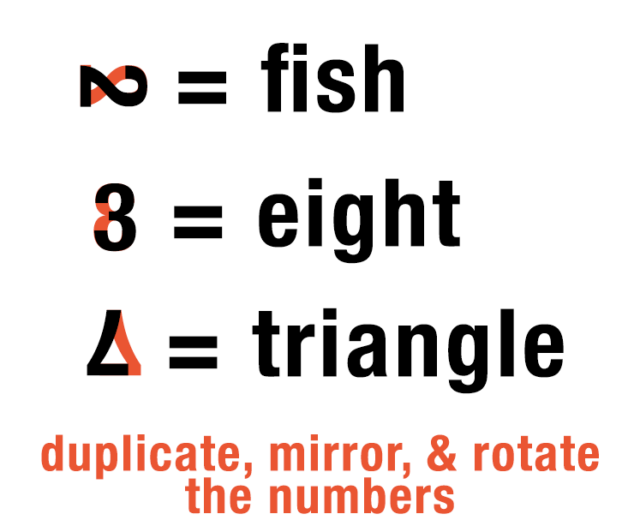 |

.
Brain Teaser #3 – Light Switch Problem

You have three incandescent lightbulbs in a small room. Each is controlled by its own light switch outside the room where you cannot see the bulbs or their light. You can flip as many light switches as you want, but you can only check the room once. How do you determine which switch controls each bulb?
Get a HintIncandescent lightbulbs have more than one property that may be useful. |
Reveal AnswerFlip the first switch on for a few minutes, then flip it off. Flip the second switch and then go check the room. The light that is on is controlled by the second switch. The light that is warm to the touch is controlled by the first switch. The light that is cold is controlled by the third switch. |
Brain Teaser #4 – 9-Dot Puzzle
If you had a print-out of this grid of nine dots, using a pen or pencil, connect all the dots by drawing only four or less straight interconnected line segments without picking the pen up from the paper once you begin. (Wikimedia Commons)
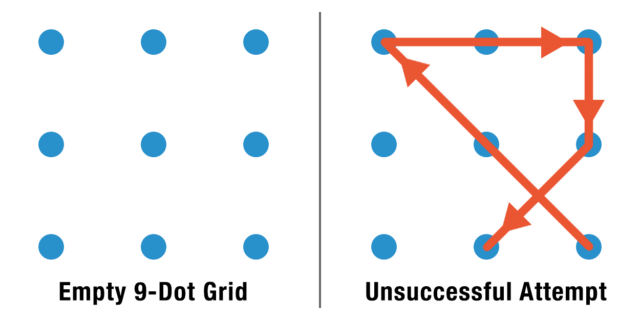
Get a HintTry venturing outside the grid of dots. |
Reveal AnswersThe solution requires extending your lines outside the grid of nine. Your line segment corners do not have to land on a dot. There are two possible solutions. 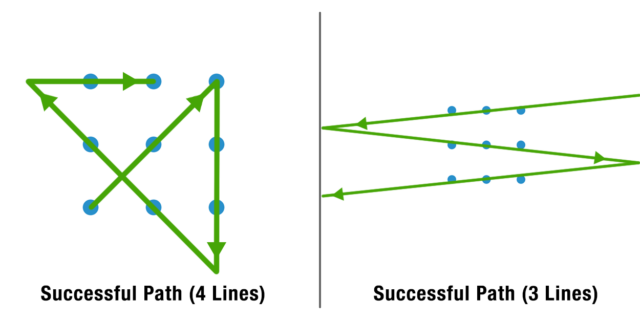 |
Brain Teaser #5 – Birthday Season

Jane was born on Dec. 28th, yet her birthday always falls in the summer. How is this possible?
Get a HintNot everyone lives in the same place. |
Reveal AnswerJane lives in the southern hemisphere. |
Brain Teaser #6 – Escape Plan
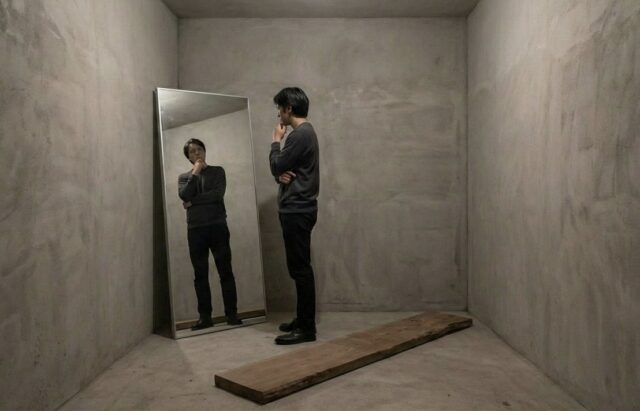
You are stuck in a concrete room with no windows or doors. The room has only a mirror and a wooden plank for you to use. How do you get out?
Get a HintThis is a fantasy play on words, not a physical solution. |
Reveal AnswerLook in the mirror to see what you “saw.” Take the saw and cut the plank in half. You now have two halves which make a “whole.” Climb through the hole to escape! |
Riddles
Here are six riddles to keep their minds moving. Riddles are great because the answer feels like it is within reach, but it is hard to make the connections to come up with the answer – just like real-world problems!
Riddle #1
What occurs once in a minute, twice in a moment, and never in a thousand years?
Get a HintThe word “occurs” can be misleading. |
Reveal AnswerThe letter “M” appears once in “minute”, twice in “moment”, and does not appear in “a thousand years”. |
Riddle #2
What has cities but no houses, forests but no trees, and rivers but no water?
Get a HintWhat might depict things, but not in any real detail? |
Reveal AnswerA map shows cities, forested areas, and rivers, but it doesn’t show their details or have them physically. |
Riddle #3
I am tall when I’m young, and short when I’m old. What am I?
Get a HintThere are a couple valid answers to this. Consider how things change when used. |
Reveal AnswerA candle or a pencil are shortened as they are used. |
Riddle #4
What is two words but thousands of letters?
Get a HintThis is a play on words, and the answer has two words in it. |
Reveal AnswerA “post office” has thousands of letters in it. |
Riddle #5
What is the longest word in the dictionary?
Get a HintNot the longest in number of letters. Also, the answer is not a word that measures a type of distance or time (lightyear or infinity would not be what we’re looking for). |
Reveal Answer”Smiles” – because there’s a MILE between each “s”. |
Riddle #6
Forward I am heavy. Backward I am not. What am I?
Get a HintFocus on words that are heavy. |
Reveal AnswerThe word “ton”, when spelled backward is “not”. |
Jokes
Everyone loves a good joke. They are good for brainstorming for two reasons. One, they make you think about what the punchline could be. Two, they get people laughing and comfortable. These are perfect even when you’re not the creative type.
Joke #1
The past, the present, and the future walked into a bar.
Reveal PunchlineIt was tense. |
Joke #2
What’s the difference between a literalist and a kleptomaniac?
Reveal PunchlineA literalist takes things literally, while a kleptomaniac takes things…literally. |
Joke #3
Can February march?
Reveal PunchlineNo, but April may! (February, March, April, May) |
Joke #4
I’d tell you a chemistry joke…
Reveal Punchline…but I know it wouldn’t get a reaction. |
Joke #5
I don’t mind coming to work…
Reveal Punchline…it’s the eight-hour wait to go home that I can’t stand. |
Joke #6
Did you hear about the first restaurant to open on the moon?
Reveal PunchlineIt had great food but no atmosphere. |
Physical Challenges
Some ice breakers are physical challenges, and these are the ones that are an exception of to my rule (of not liking ice breakers). Get people up and moving, blood flowing, minds engaged, and working together to solve a problem!
Challenge #1 – Marshmallow Tower
Each team or person is asked to build a tower as tall as they can using just 20 sticks of dry spaghetti and 20 mini-marshmallows. How tall of a structure can each team get by sticking dry spaghetti into the mini-marshmallows?
This is a trial-and-error activity, those who are not afraid to fail and retry will do the best – children often outperform adults in this exercise. If you have true engineers in the session, they will likely win.
Challenge #2 – The Human Knot
This is a team exercise, so you’ll need 4+ people per team. Each team should stand in a tight shoulder-to-shoulder circle then each member needs to grab hands with two different people in the group. The team must work together to untangle their circle.
Hands must not let go except for a minor change of holding position for comfort. It is not allowed to let go in order to help untangle or to provide additional room. They can step over, under, and through people’s arms. In larger groups it may be possible to untangle into more than one circle.
Challenge #3 – Blindfold Course
Create an obstacle course using chairs, cones, ropes, office supplies…whatever you come up with. Blindfold one team member and have the others guide them through the course using only verbal commands. No touching. No peeking.
Challenge #4 – Toxic Waste Removal
Fill a small bucket with tennis balls (“toxic waste”) and place in the center of a boundary circle of about 10-20 feet in diameter. No one can directly touch the toxic waste or enter the circle. Provide team members with tools such as rope, string, bungee cords, yard sticks, or similar items. The group must find a way to use the tools to get the toxic waste out of the circle and into another small “containment” bucket outside the circle.
Challenge #5 – The Architect
In small groups, one person will be designated the “Architect”, all other group members will be blindfolded. Provide some sort of building materials such as LEGO® bricks, paper cups, straws, tape, or whatever you like. The Architect must verbally instruct the blind “Builders” on how to build something from the materials. This might be a tower judged on height, or a structure judged on creativity. Only the Builders can touch the building materials. If time allows, you can break halfway through, allow the Builders to remove blindfolds and discuss, and then do one last round blindfolded again and guided by the Architect.
Challenge #6 – Paper Airplane Challenge
Start this activity by asking each participant to build a paper airplane on their own. Throw the planes down a hall or in an open area and see whose flies the furthest. Then have small groups build a paper plane together (now that they’ve seen which one flew the best). See which group can win the second round.
Add a Twist at the EndThe facilitator can crumple a sheet of paper into a ball and throw it to see if it flies further than the planes. Whether it does or not, this is a great example of how teams can break convention and bend rules. |
Conclusion
I hope you find some of these mind games fun! People who dislike ice breakers will likely find more enjoyment with these mental exercises. But these are more than just fun, these are intentional aids to get people thinking in a new way before you ask them to provide you with industry-changing ideas in a brainstorming session!
……
If you are looking for a partner who will play fun mind games with you, reach out to your Perficient account manager or use our contact form to begin a conversation.