
Moments of currency change are where fortunes are made and lost. In January 2026, Bulgaria will enter one of those moments. The country will adopt the euro and officially retire the Bulgarian lev, marking a major euro adoption milestone and reshaping how investors, banks, and global firms manage currency risk in the region. The shift represents one of the most significant macroeconomic transitions in Bulgaria’s modern history and is already drawing attention across FX markets.
To understand how dramatically foreign exchange movements can shift value, consider one of the most famous examples in modern financial history. In September 1992, investor George Soros, “the man who broke the British Bank,” bet against the British pound, anticipating that the UK’s exchange rate policy would collapse. The resulting exchange rate crisis, now known as Black Wednesday, became a defining moment in forex trading and demonstrated how quickly policy decisions can trigger massive market dislocations.
By selling roughly $10 billion worth of pounds, his Quantum Fund earned ~$1 billion in profit when the currency was forced to devalue. The trade earned Soros the nickname “the man who broke the Bank of England” and remains a lasting example of how quickly confidence and capital flows can move entire currency systems.
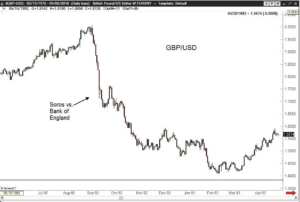
GBP/USD exchange rate from May 1992 to April 1993, highlighting the dramatic plunge during Black Wednesday. When George Soros famously shorted the pound, forcing the UK out of the ERM and triggering one of the most significant currency crises in modern history
To be clear, Bulgaria is not in crisis. The Soros example simply underscores how consequential currency decisions can be. Even when they unfold calmly and by design, currency transitions reshape the texture of daily life. The significance of Bulgaria’s transition becomes more clear when you consider what the lev has long represented. Safety. Families relied on it through political uncertainty and economic swings, saved it for holidays, passed it down during milestones, and trusted it in moments when little else felt predictable. Over time, the lev became a source of stability as Bulgaria navigated decades of change and gradually aligned itself with the European Union..
Its retirement feels both symbolic and historic. But for global markets, currency traders, banks, and companies engaged in cross border business, the transition is not just symbolic. It introduces real operational changes that require early attention. This article explains what is happening, why it matters, and how organizations can prepare.
Some quick facts help frame the scale of this shift.

Map of Bulgaria
Bulgaria has a population of roughly 6.5 million.
The country’s GDP is about 90 billion U.S. dollars (World Bank, 2024)
Its largest trade partners are EU member states, Turkey, and China.
Why Bulgaria Is Adopting the Euro
Although the move from the Lev to the Euro is monumental, many Bulgarians also see it as a natural progression. When Bulgaria joined the European Union in 2007, Euro adoption was always part of the long-term plan. Adopting the Euro gives Bulgaria a stronger foundation for investment, more predictable trade relationships, and smoother participation in Europe’s financial systems. It is the natural next step in a journey the country has been moving toward slowly, intentionally, and with growing confidence. That measured approach fostered public and institutional trust, leading European authorities to approve Bulgaria’s entry into the Eurozone on January 1, 2026 (European Commission, 2023; European Central Bank, 2023).
How Euro Adoption Affects Currency Markets
Bulgaria’s economy includes manufacturing, agriculture, energy, and service sectors. Its exports include refined petroleum, machinery, copper products, and apparel. It imports machinery, fuels, vehicles, and pharmaceuticals (OECD, 2024). The Euro supports smoother trade relationships within these sectors and reduces barriers for European partners.
Once Bulgaria switches to the Euro, the Lev will quietly disappear from global currency screens. Traders will no longer see familiar pairs like USD to BGN or GBP to BGN. Anything involving Bulgaria will now flow through euro-based pairs instead. In practical terms, the Lev simply stops being part of the conversation.
For people working on trading desks or in treasury teams, this creates a shift in how risk is measured day to day. Hedging strategies built around the Lev will transition to euro-based approaches. Models that once accounted for Lev-specific volatility will have to be rewritten. Automated trading programs that reference BGN pricing will need to be updated or retired. Even the market data providers that feed information into these systems will phase out Lev pricing entirely.
And while Bulgaria may be a smaller player in the global economy, the retirement of a national currency is never insignificant. It ripples through the internal workings of trading floors, risk management teams, and the systems that support them . It is a reminder that even quiet changes in one part of the world can require thoughtful adjustments across the financial landscape.

Combined with industry standard year-end code-freezes, Perficient has seen and helped clients stop their Lev trading weeks before year-end.
The Infrastructure Work Behind Adopting the Euro
Adopting the Euro is not just a change people feel sentimental about. Behind the scenes, it touches almost every system that moves money. Every financial institution uses internal currency tables to keep track of existing currencies, conversion rules, and payment routing. When a currency is retired, every system that touches money must be updated to reflect the change.
This includes:
- Core banking and treasury platforms
- Trading systems
- Accounting and ERP software
- Payment networks, including SWIFT and ISO 20022
- Internal data warehouses and regulatory reporting systems
Why Global Firms Should Pay Attention
If the Lev remains active anywhere after the transition, payments can fail, transactions can be misrouted, and reconciliation issues can occur. The Bank for International Settlements notes that currency changes require “significant operational coordination,” because risk moves across systems faster than many institutions expect.
Beyond the technical updates, the disappearance of the Lev also carries strategic implications for multinational firms. Any organization that operates across borders, whether through supply chains, treasury centers, or shared service hubs, relies on consistent currency identifiers to keep financial data aligned. If even one system, vendor, or regional partner continues using the old code, firms can face cascading issues such as misaligned ledgers, failed hedging positions, delayed settlements, and compliance flags triggered by mismatched reporting. In a world where financial operations are deeply interconnected, a seemingly local currency change can ripple outward and affect global liquidity management and operational continuity.
Many firms have already started their transition work well in advance of the official date in order to minimize risk. In practice, this means reviewing currency tables, updating payment logic, testing cross-border workflows, and making sure SWIFT and ISO 20022 messages recognize the new structure.
Trade Finance Will Feel the Change
For people working in finance, this shift will change the work they do every day. Tools like Letters of Credit and Banker’s Acceptances are the mechanisms that keep international trade moving, and they depend on accurate currency terms. If any of these agreements are written to settle in Lev, they will need to be updated before January 2026.
That means revising contracts, invoices, shipping documents, and long-term payment schedules. Preparing early gives exporters, importers, and the teams supporting them the chance to keep business running smoothly through the transition.
What Euro Adoption Means for Businesses
Switching to the Euro unlocks several practical benefits that go beyond finance departments.
- Lower currency conversion costs
- More consistent pricing for long-term agreements
- Faster cross-border payments within the European Union
- Improved financial reporting and reduced foreign exchange risk
- Increased investor confidence in a more stable currency environment
Because so much of Bulgaria’s trade already occurs with Eurozone countries, using the Euro simplifies business operations and strengthens economic integration.
How Organizations Can Prepare
The most important steps for institutions include:
- Auditing systems and documents for references to BGN
- Updating currency tables and payment rules
- Revising Letters of Credit and other agreements that list the Lev
- Communicating the transition timeline to partners and clients
- Testing updated systems well before January 1, 2026
Early preparation ensures a smooth transition when Bulgaria officially adopts the Euro. Ensure that operationally you’re prepared to accept Lev payments through December 31, 2025, but given settlement timeframes, prepared to reconcile and settle Lev transactions into 2026.a
Final Thoughts
The Bulgarian Lev has accompanied the country through a century of profound change. Its retirement marks the end of an era and the beginning of a new chapter in Bulgaria’s economic story. For the global financial community, Bulgaria’s adoption of the Euro is not only symbolic but operationally significant.
Handled thoughtfully, the transition strengthens financial infrastructure, reduces friction in global business, and supports a more unified European economy.
References
Bank for International Settlements. (2024). Foreign exchange market developments and global liquidity trends. https://www.bis.org
Eichengreen, B. (1993). European monetary unification. Journal of Economic Literature, 31(3), 1321–1357.
European Central Bank. (2023). Convergence report. https://www.ecb.europa.eu
European Commission. (2023). Economic and monetary union: Euro adoption process. https://ec.europa.eu
Henriques, D. B. (2011). The billionaire was not always so bold. The New York Times.
Organisation for Economic Co-operation and Development. (2024). Economic surveys: Bulgaria. https://www.oecd.org
World Bank. (2024). Bulgaria: Country data and economic indicators. https://data.worldbank.org/country/bulgaria


Thoughtful and timely analysis—your breakdown of how Bulgaria’s 2026 euro adoption could affect inflation expectations, bank operations, and capital markets brings much-needed clarity to a complex transition.