At the Healthcare Interactive Conference (HCIC) last month, I got to talk to marketers who are very focused on results. They are also very focused on what will impact their marketing efforts and why. Every conversation came back to AI.
In my previous HCIC takeaway, I wrote about how AI is not a strategy—it’s a tool to solve real problems. Now I want to dig into a specific problem AI is creating for healthcare marketers: how we get found. We need to be thinking about all aspects of how AI can be used. In general, this breaks down into both impact and opportunity.
Impact: AI Search Is Transforming Healthcare Discovery
Several conference sessions alluded to this shift, but marketing experts Brittany Young and Gina Linville gave some deeper insight.
From a marketing perspective, the largest impact is one of being found. Think about how much time a typical hospital marketer puts into being found. I have had many conversations over the years about Search Engine Optimization (SEO) and the importance of having valuable content that the search engines view as unique and relevant.
AI impacts that in ways that are not at first obvious.
The New Reality of Patient Search
Think of how you typically use ChatGPT or how your search engine has evolved. AI now pulls the data and gives you a brief with information culled from multiple online sources. The good news is that the AI tool will typically reference a website it sources. The bad news is while AI typically credits source websites, patients get their answers without ever clicking through to your site.
The scale of this shift is staggering:
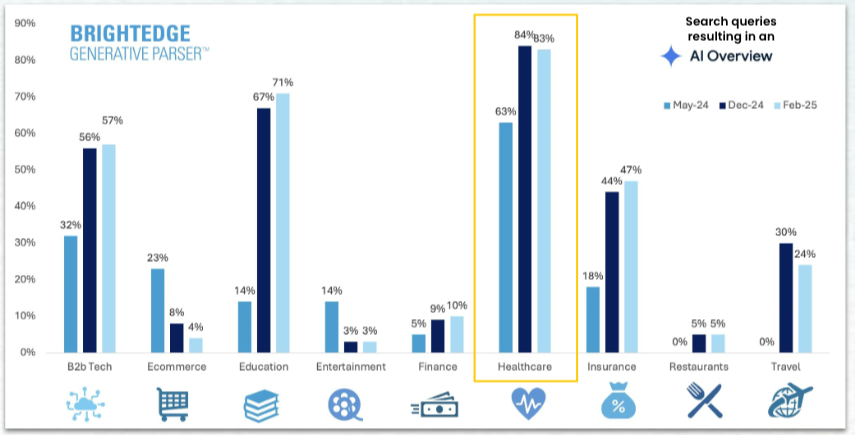
AI provides an overview for up to 84% of search queries when it comes to healthcare questions.
Healthcare leads nearly every sector in AI-powered search results—a trend that’s accelerating:
Strategic Response: Winning at AI Search in Healthcare

This shift demands a fundamental rethinking of content strategy. Two concepts are emerging as critical:
1) Answer Engine Optimization (AEO)
- Answer Engine Optimization (AEO) is the practice of structuring and optimizing content so that AI-powered systems, such as Google’s AI Overviews, ChatGPT, Perplexity AI, and voice assistants, can easily identify, extract, and cite it as a direct answer to user queries.
2) Generative Engine Optimization (GEO)
- Generative Engine Optimization (GEO) is a digital marketing technique designed to improve a brand’s visibility in results produced by generative artificial intelligence (GenAI) platforms. It involves adapting digital content and online presence to ensure that AI systems can accurately interpret, cite, and use the content when generating responses to user queries.
The imperative is clear: Organizations that don’t optimize for AI-powered discovery won’t just lose rankings—they’ll lose visibility entirely.
If you are not already thinking about how to orient your content to this then be aware that you will soon feel an impact.
Opportunity: Agentic AI and Productivity
On the flip side of the coin is the opportunity. While the impact above provides you with an opportunity provided you react appropriately, I want to focus on the productivity part of this. Specifically, think of what Agentic AI can do for your organization.
What Traditional Campaign Development Looks Like
Let me give you a few examples of common tasks and how long they typically take:
- Create a campaign brief: up to two weeks
- Create copy across multiple channels: 8-16 hours
- Create digital assets related to the campaign which fit your brand standards and work in each individual channel. Web site may allow for larger images. Paid search or paid social may have limited space: 40 hours
- Creation of the segment and pushing it to marketing automation tools: several hours
Now imagine specialized AI agents handling each component—not replacing human strategy and judgment, but accelerating execution while maintaining brand standards and compliance. Just getting one campaign going across multiple channels become a multi-person engagement over several weeks. While focused on that, you won’t focus on additional campaign or in honing your craft.
The AI Agent Team Your Marketing Organization Needs
The answer lies with Agentic AI. We believe that AI can cut down on the time necessary to complete these tasks and still keep humans in the loop. Here are a few examples of agents you might need in your organization:
| Agent Name | Purpose |
| Hunter | Prospect identification and acquisition specialist that hunts down leads using predictive AI and behavioral signals. |
| Oracle | Predictive intelligence that forecasts customer behavior, market trends, and campaign performance. |
| Conductor | Omnichannel orchestration that translates strategy into compliant high performing journeys. |
| Guardian | Predictive retention specialist that monitors satisfaction predicts churn and intervenes to preserve valuable relationships. |
| Artisan | Creative engine that operationalizes Gen AI to produce on-brand assets at scale. |
| Advisor | Strategic marketing consultant that provides real-time recommendations and optimizes campaigns based on performance data. |
| Conversational | Engages prospect across chat, email and social with context awareness. |
| Sentinel | Compliance and security that ensure all marketing activities adhere to HIPAA regulations. |
| Segmentation | Discovers audience segments and builds new segments for activation. |
| Bridge | Content Migration specialist to seamlessly transfer content between platforms. |
| Scribe | Copywriting specialist to create compelling on brand copy. |
| Forge | App migration specialist to assist with code generation and web development. |
Most importantly, this frees your marketing team to focus on what AI can’t do: strategic thinking, creative problem-solving, and understanding the nuanced needs of your community.
The Path Forward: Integration, Not Replacement
The organizations winning in this new landscape aren’t choosing between human expertise and AI capabilities. They’re strategically integrating both.
Success requires more than technology. It needs an integrated approach:
- Rethinking discoverability through AEO and GEO optimization
- Deploying specialized AI agents for productivity acceleration
- Maintaining human oversight for strategy, creativity, and judgment
- Ensuring compliance at every step, particularly in heavily regulated healthcare
- Measuring impact against business outcomes, not just operational metrics
Enabling Healthcare Organizations To Lead This Shift
HCIC reminded us that success in healthcare marketing isn’t about chasing technology for its own sake. As I shared in my first HCIC takeaway, AI is not a strategy—it’s a tool to solve real challenges that impact your organization’s ability to connect patients to care.
The search revolution is here. The productivity opportunity is real. The organizations that move quickly to optimize for AI-powered discovery while deploying strategic AI agents will gain a competitive advantage that compounds over time.
Start a conversation with our experts today.