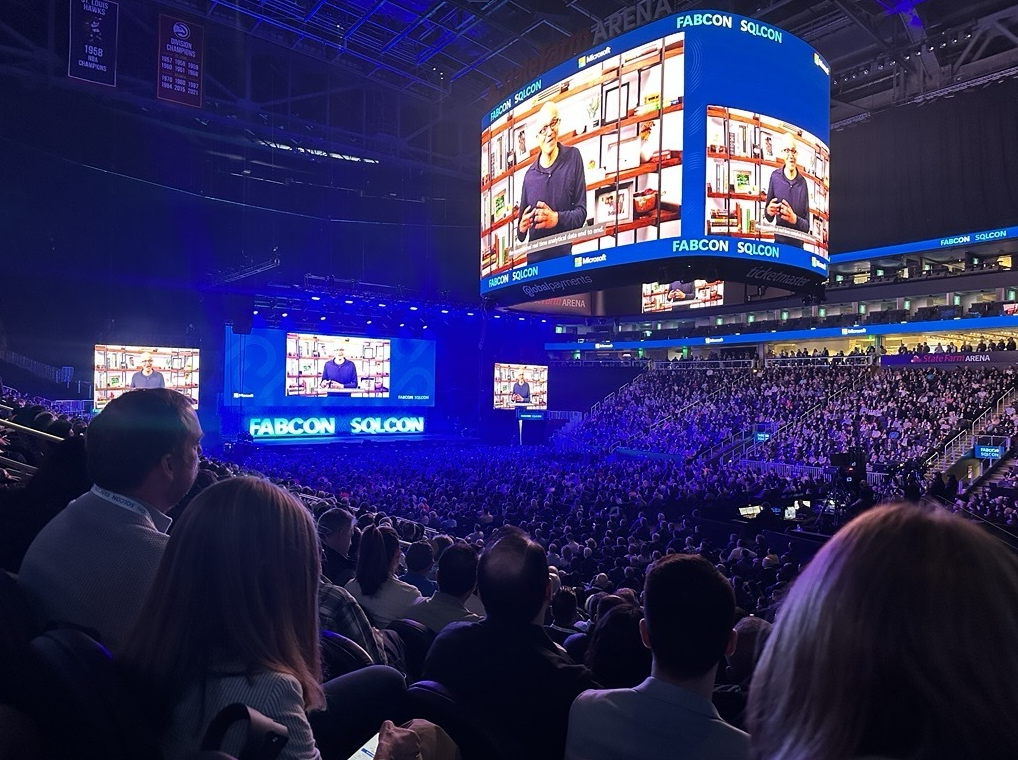
FabCon 2026 in Atlanta marked a major turning point for Microsoft Fabric and organizations accelerating toward unified, AI‑ready data estates. This year’s announcements weren’t just incremental feature updates; they signaled a shift toward a converged data and intelligence platform that spans databases, analytics, real‑time intelligence, AI agents, and semantic understanding.
Perficient was proud to participate onsite as a Platinum sponsor, allowing us to connect with hundreds of attendees, share our perspective at Booth #833 and our welcome happy hour, and deliver our session, “The Golden Thread: Architecting an End-to-End OneLake Fabric Ecosystem for Analytics, Real-Time Intelligence & RAG.”
Below is our take on the updates that matter most and what they mean for the next generation of enterprise data platforms.
1. OneLake Matures Into the Enterprise Data Foundation
One of the strongest signals at FabCon was the continued expansion of OneLake as the central data foundation for the enterprise. The introduction of the new Database Hub, which brings SQL Server, Azure SQL, PostgreSQL, MySQL, and Cosmos DB into the Fabric experience, cements Microsoft’s intention to unify transactional, operational, and analytical workloads under a single architecture.
Combined with expanded OneLake interoperability and deeper zero‑copy shortcuts, the direction is unmistakable: organizations should prepare for a world where movement of data becomes the exception, not the rule.
The platform is shifting toward metadata‑driven orchestration, simplified pipelines, and a significant reduction in the need for external ETL tools.
This is exactly the direction many of the teams we met with have been pushing toward: eliminating duplication, lowering operational complexity, and moving toward a foundation that is AI‑ready by default.
2. Fabric Evolves Into an Intelligence Layer, Not Just a Data Platform
Multiple keynotes highlighted Fabric’s evolution from a data platform into a unified intelligence layer was one of the clearest storylines at the event. The debut of Fabric IQ represents Microsoft’s commitment to advancing beyond storage and computation toward semantic understanding.
Fabric IQ introduces Ontologies, Graph, and semantic reasoning as first‑class platform capabilities. This unlocks an entirely new category of enterprise AI:
- Ontologies establish a shared business vocabulary
- Graph enables deep relationship reasoning
- Data Agents operate within those rules, grounding AI in business context rather than model guesswork
This architecture mirrors the hybrid RAG approach Perficient has implemented manually for years—where structured knowledge constrains the reasoning space and vector retrieval fills in the unstructured gaps. By making semantic grounding native, Fabric is moving toward AI systems that can take safe, auditable actions, not just produce outputs.
The shift is clear: the next frontier in enterprise AI isn’t bigger models but better grounding.
3. Real-Time Intelligence Becomes the Default
FabCon also made it clear that real‑time data is transitioning from an advanced capability to a default operational expectation.
Expanded Real‑Time Intelligence capabilities, unified batch + streaming processing, and deeper telemetry fusion into Medallion architectures all reinforce this trend. Many teams told us they’re outgrowing batch pipelines, and these updates reflect Microsoft’s commitment to delivering analytics and decision‑making while data is still in motion.
For Perficient, this aligns directly with the Golden Thread approach—where real‑time signals and historical context converge to unlock high‑value scenarios like anomaly detection, operational awareness, and predictive insights.
4. Fabric Becomes the Unified Data Control Plane
Perhaps the most important macro‑signal at FabCon was how deliberately Microsoft positioned Fabric as a unified control plane across the data estate. With databases, analytics, governance, security, orchestration, and AI all converging into a single platform, the architectural direction is now clear: reduce fragmentation, simplify the stack, and centralize control so organizations can move faster and operate more consistently.
This is more than consolidation—it’s the foundation for enterprise-scale AI. A unified control plane speeds insight development, lowers operational overhead, and enables organizations to standardize the architectural patterns that underpin AI‑ready data.
5. Skills for Fabric: Agentic Automation Raises the Bar for Developers
Another standout announcement was Skills for Fabric, an open‑source library that introduces agentic automation into the Fabric development workflow. Rather than “closing the skills gap,” these capabilities augment developers through automation and Model Context Protocol (MCP) support.
Skills for Fabric streamlines tasks that once consumed days: provisioning Lakehouses and Warehouses, configuring pipelines, setting up medallion scaffolding, and preparing developer environments. Through integrations with GitHub Copilot, Claude Code, VS Code, and the CLI, teams can now leverage AI to generate code, plan multi-step workflows, provision Fabric resources, validate patterns, and deploy artifacts end‑to‑end.
But this raises the bar, not lowers it. Organizations now need developers who understand how to:
- configure agentic workflows
- evaluate AI‑generated infrastructure
- work safely within MCP
- architect Fabric environments for agent operations
Perficient’s engineering teams are already leveraging these capabilities internally to shift client time away from infrastructure setup and toward modeling, semantics, and insight delivery.
Looking Ahead: How Perficient Helps Organizations Move Faster
Across FabCon, one theme came through clearly: Fabric is becoming the AI‑native operating layer for the enterprise. The future is zero‑copy, metadata-driven, real‑time, semantically grounded, and agent‑enabled.
To help teams move confidently into that future, Perficient offers our 5‑Week AI AMP, a focused engagement that helps organizations rapidly identify high‑value AI opportunities, prioritize RAG/RTI/ML scenarios, and build a Fabric‑aligned proof of concept that accelerates time to value.
With Database Hub, Real‑Time Intelligence, Dataflow Gen2, Fabric IQ, and agentic development now reshaping the platform, organizations have a rare opportunity to simplify their architecture and activate intelligence at scale. Perficient is ready to help teams turn this momentum into meaningful outcomes—moving from what’s possible to what’s proven.
Ready to Start Your Fabric Journey?
Connect with our experts to discuss your roadmap or explore how our expertise can help you move faster.
Download our “Golden Thread” session deck | Request an AI AMP briefing with our team