From the limits of synchronous REST architectures to the core building blocks of Kafka — topics, partitions, offsets, producers, and consumer groups.
Every engineering team eventually hits the same wall. The system is growing. More services. More traffic. And all those services are talking directly to each other — synchronous HTTP calls, request-response, point-to-point. It works fine at small scale. Then it doesn’t.
Apache Kafka® was built for exactly this moment. In this first post of our three-part series, we’ll cover why traditional architectures break, what Kafka fundamentally is, and the core building blocks you need to understand before you use it in production.
What Breaks in Synchronous, Point-to-Point Architectures
When every service calls every other service directly, you don’t have a microservices architecture — you have a distributed monolith with extra network hops.
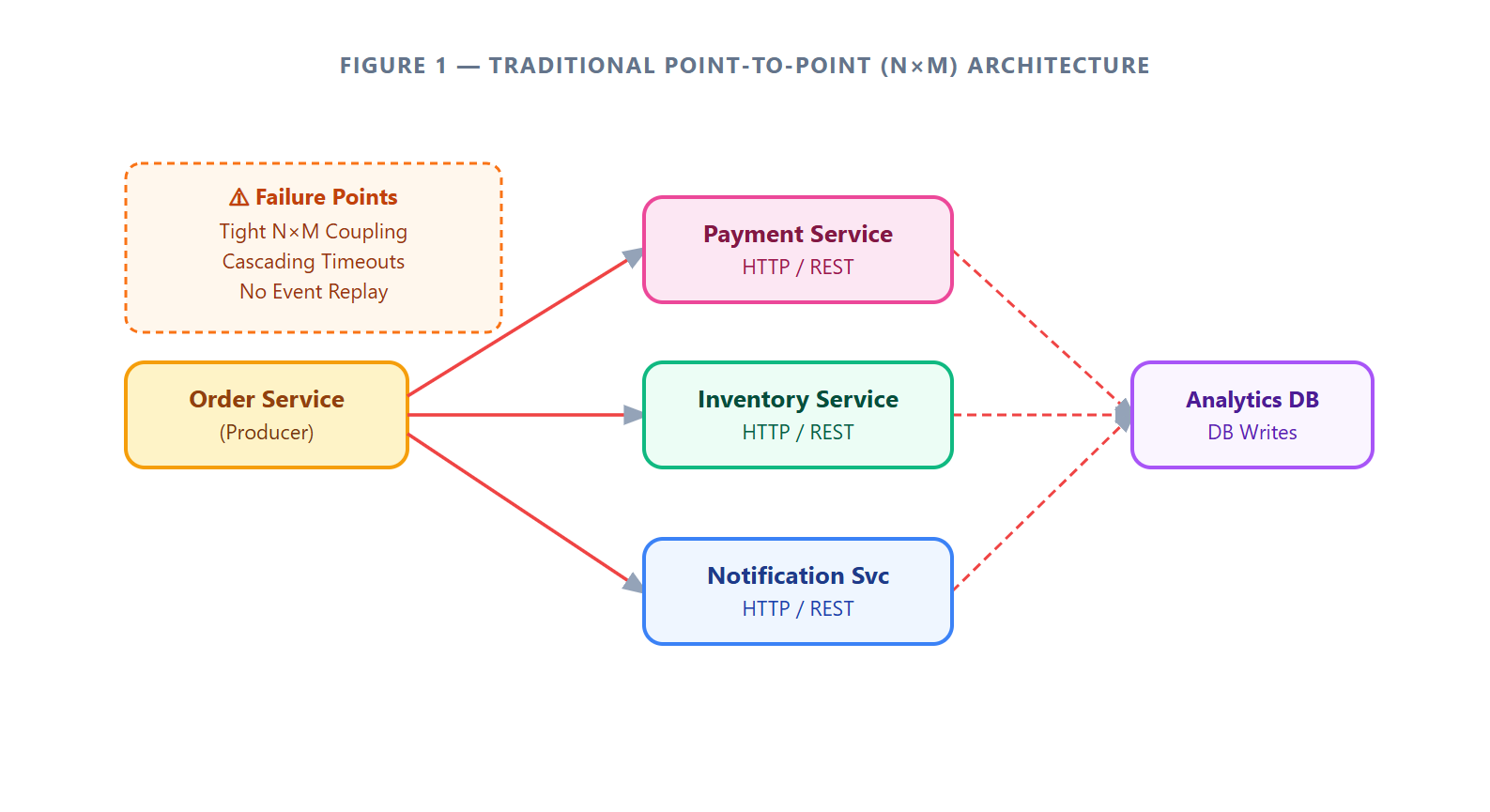
Imagine an order is placed on an e-commerce platform. The Order Service needs to notify the Inventory Service, trigger the Payment Service, fire the Notification Service, and record an event in the Analytics Database. In a synchronous architecture, every one of those calls is a direct HTTP dependency.
Why This Architecture Fails at Scale
- N×M Complexity: With 5 producers and 5 consumers, you potentially have 25 direct integrations to maintain. Add one new service and you’re updating everything upstream.
- Cascading Failures: If the Notification Service slows down, it backs up the Order Service. A single slow dependency can bring down the whole request chain.
- Over-Provisioning: Every service must be sized for the maximum possible traffic spike, even if that spike only lasts 60 seconds on Black Friday. The rest of the year, that compute sits idle.
- No Event History: Once the HTTP response is sent, the event is gone unless you explicitly wrote it to a database. There’s no way to replay what happened or onboard a new consumer against historical data.
The Real Cost
Synchronous tight coupling doesn’t just cause outages — it slows down your engineering team. Every new feature requires coordinating changes across multiple services simultaneously, because they all depend on each other’s availability.
Enter Apache Kafka: The Distributed Commit Log
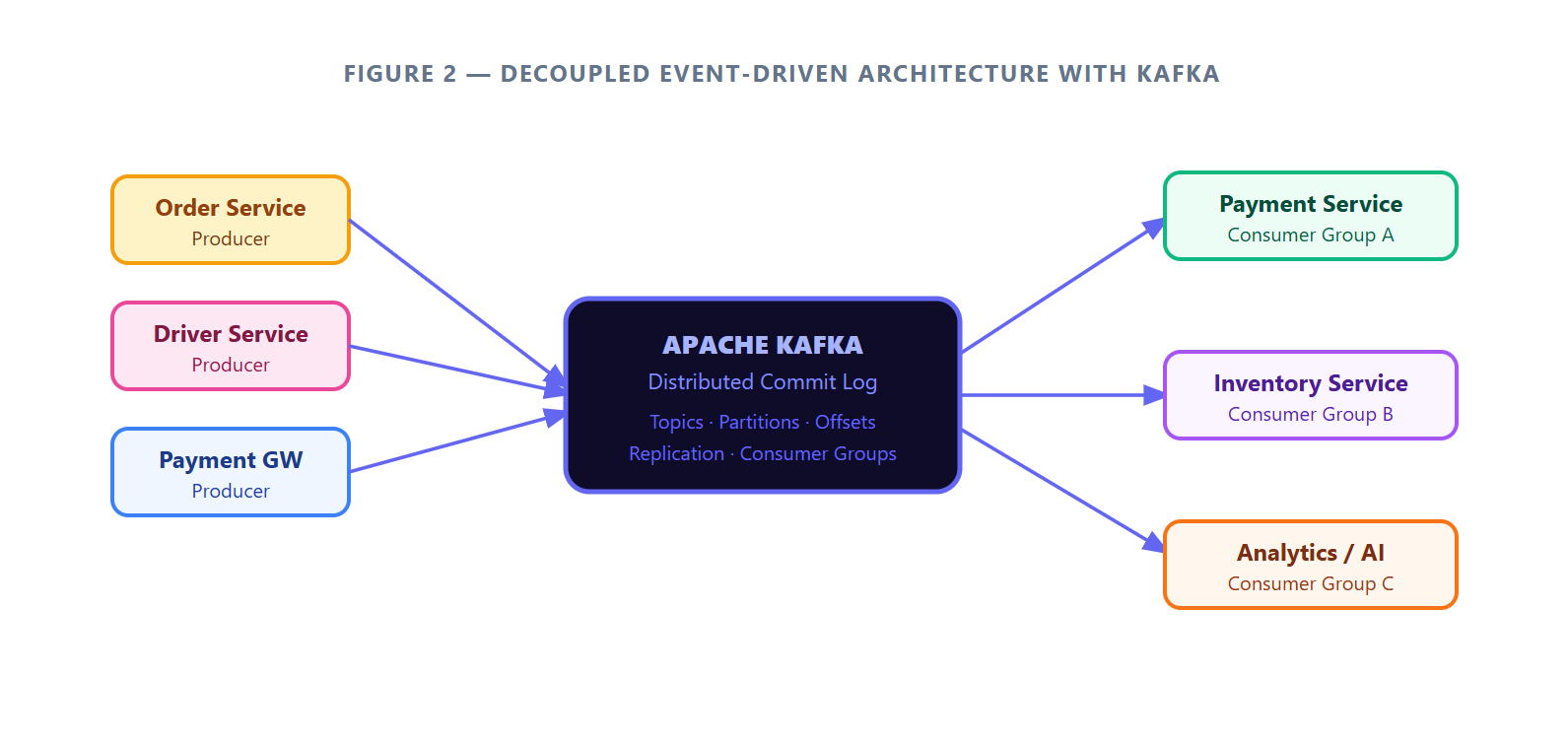
Kafka replaces N×M direct connections with a single durable, replayable event log. Producers and consumers never know about each other.
Apache Kafka is, at its core, a distributed, append-only commit log. Producers write events to it. Consumers read from it. Neither side knows the other exists. This single design decision eliminates nearly every problem listed above.
The Key Insight
In Kafka’s model, you can add a brand new consumer (a new feature, a new analytics engine, a new AI model) to any topic without changing a single line of producer code. The producer has no idea the new consumer exists.
The Building Blocks of Kafka You Must Understand
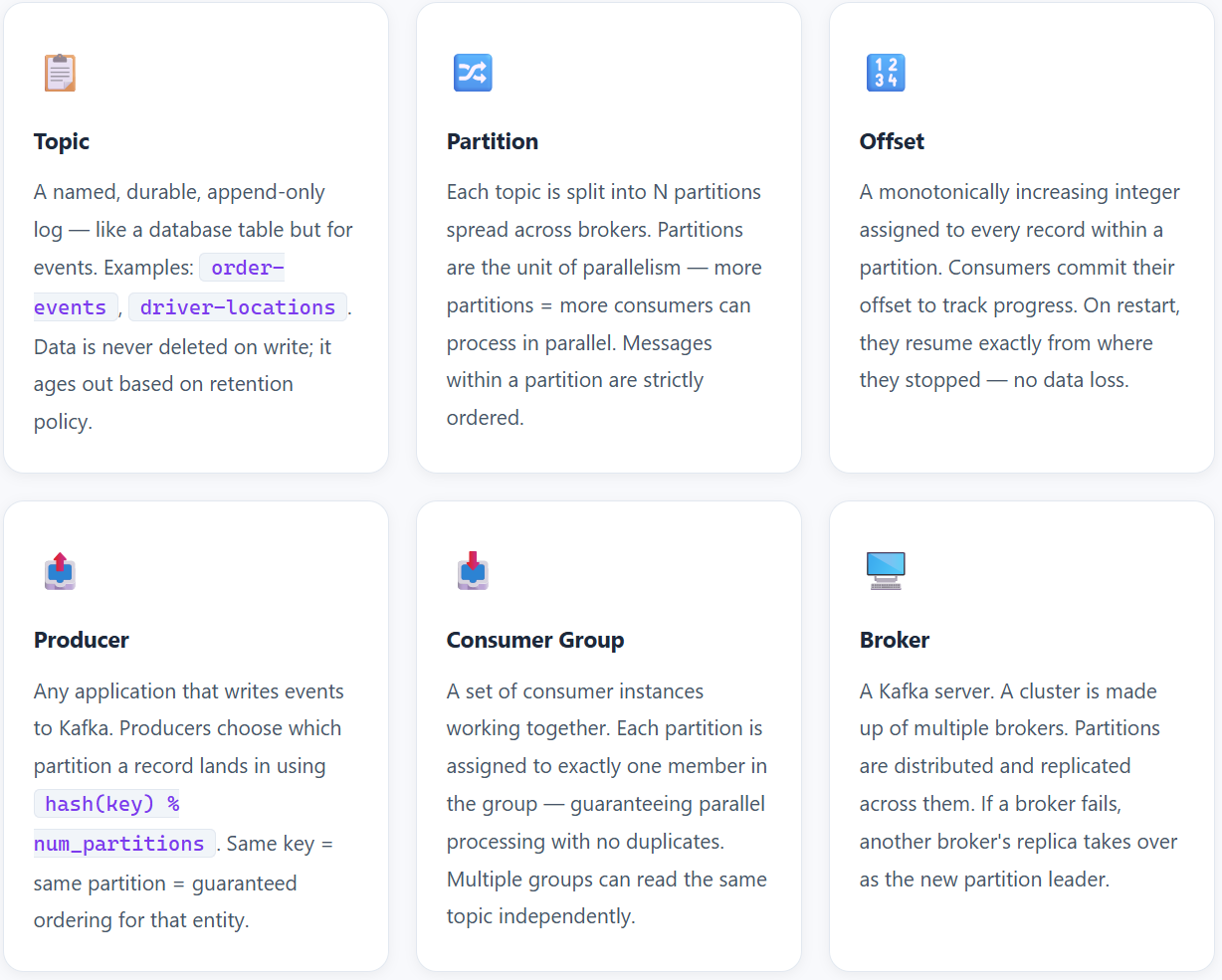
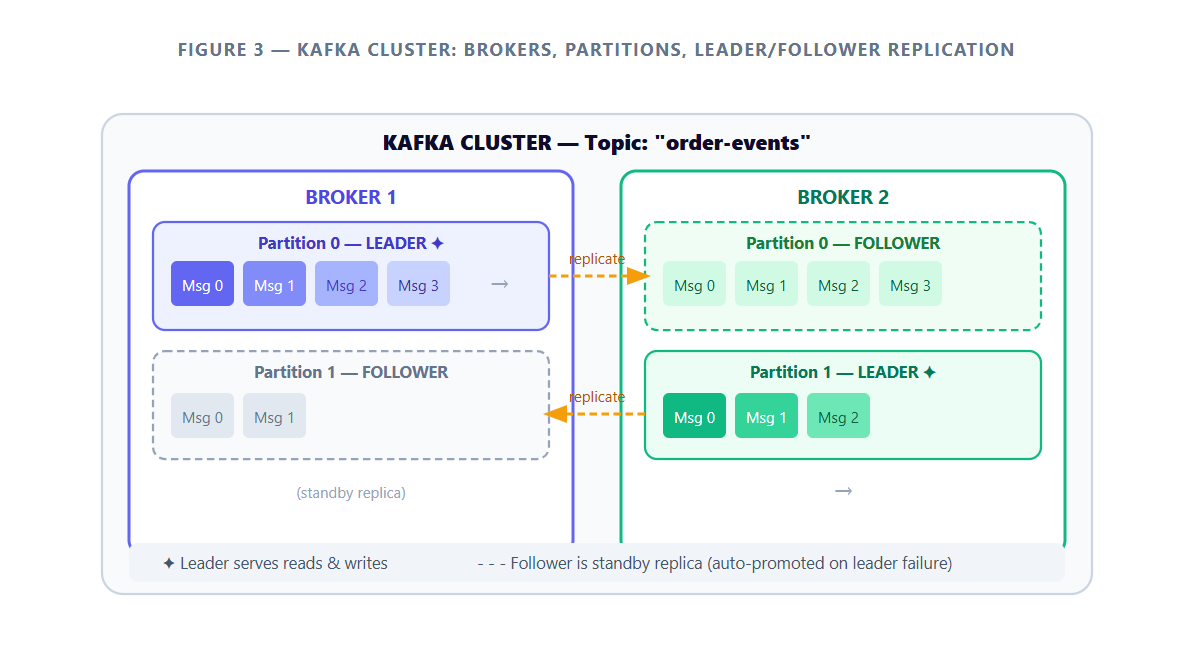
Before you deploy a single Kafka cluster, you need these six concepts locked in. Everything else — performance, reliability, and correctness — flows from them.
How Partitions Enable Scale and Ordering
Consumer Groups in Action
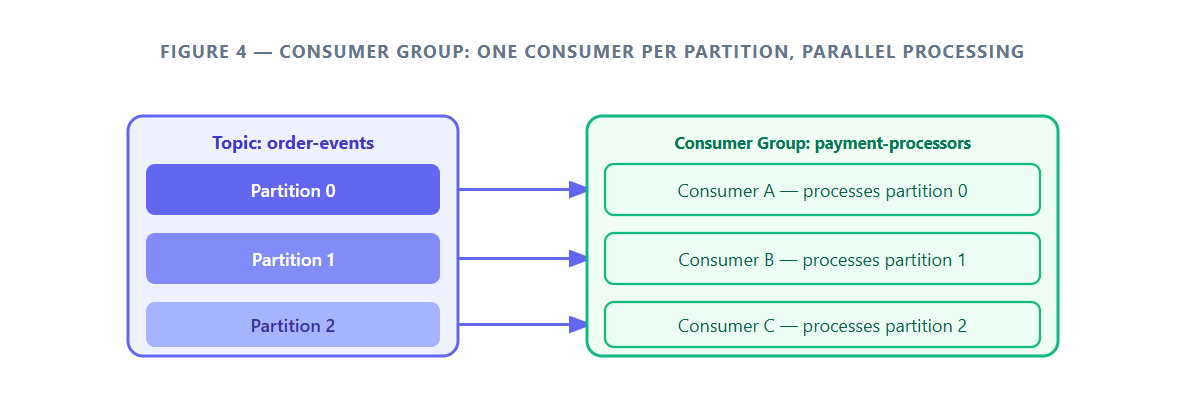
One of the most powerful Kafka concepts: a topic with 3 partitions can be consumed by up to 3 consumers within a single group — each consumer owns one partition, processing in true parallel with no duplication.
What You’ve Learned in Part 1
- Why synchronous, point-to-point architectures fail under high traffic and tight coupling
- How Kafka’s Distributed Commit Log decouples producers from consumers entirely
- The six core Kafka primitives: Topics, Partitions, Offsets, Producers, Consumer Groups, and Brokers
- How Leader/Follower replication provides fault tolerance, and how consumer groups enable parallel processing without duplication
Coming Up in Part 2
We take all of these concepts into production. We’ll walk through the real Kafka architecture powering a Swiggy-style food delivery platform, a CI/CD deployment pipeline with Octopus Deploy, and an AI real-time inference broadcasting system — with full architecture diagrams for each.