
Three full production architecture walkthroughs — a Swiggy-style food delivery platform, an enterprise CI/CD pipeline with Octopus Deploy, and a real-time AI inference broadcasting system.
Theory is useful. Production diagrams are better. In Part 1, we covered why Kafka exists and how its core building blocks — topics, partitions, offsets, and consumer groups — fit together. Now we apply all of that to three real production architectures that represent the most common Kafka use cases in modern engineering teams.
What this post covers:
Architecture 1: Hyper-local food delivery (Swiggy-style).
Architecture 2: Enterprise CI/CD deployment governance (Octopus Deploy).
Architecture 3: Real-time AI inference broadcasting. Full data flow walkthroughs for each.
Architecture 1: Hyper-Local Food Delivery at Scale (Swiggy / Zomato Pattern)
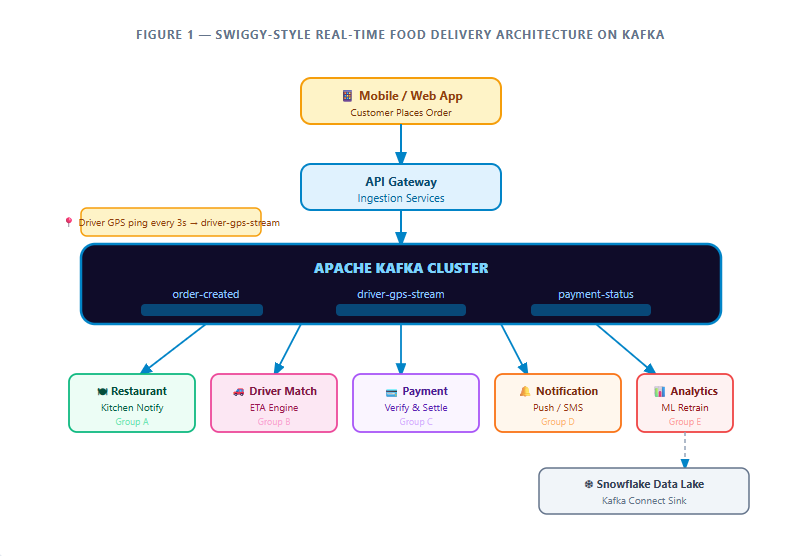
A food delivery platform is one of the most event-dense systems in existence. At peak, millions of GPS pings, order state changes, payment confirmations, and kitchen notifications all need to flow in real time — without any single service blocking another.
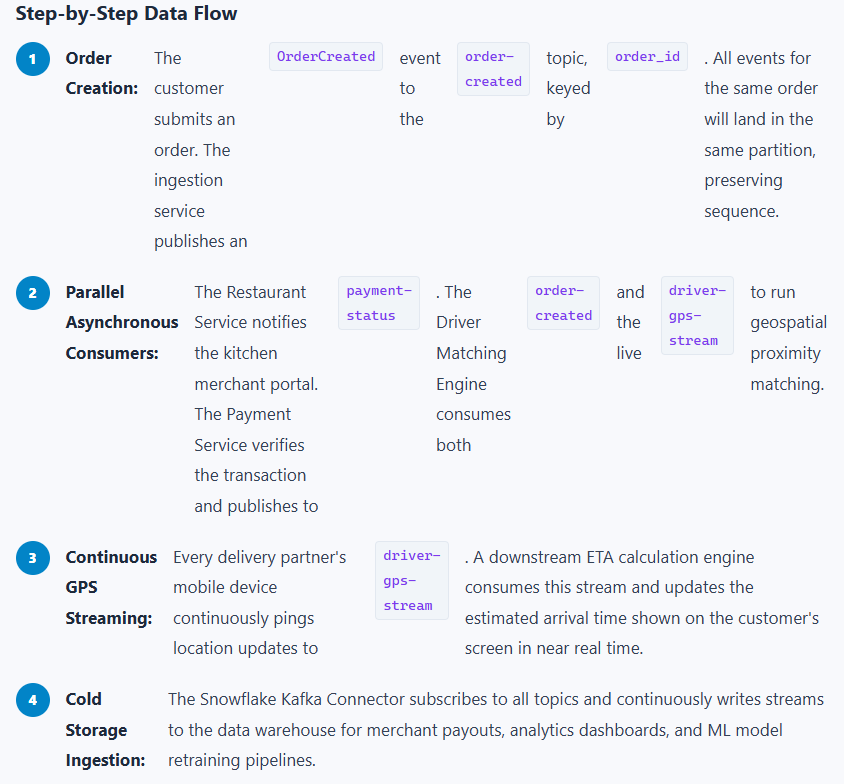
Here’s the core challenge: when a customer places an order, at least five different things need to happen simultaneously — kitchen gets notified, payment gets verified, a driver gets matched, the customer gets a push notification, and the event gets recorded for analytics. In a synchronous architecture, these are chained calls. In Kafka, they are independent consumers on the same topic.
Why This Works
The Restaurant Service, Driver Matching Engine, Payment Service, Notification Service, and Analytics Pipeline are all completely independent. If the Analytics pipeline goes down for maintenance, orders keep flowing. If the Notification Service is slow, nothing else slows with it.
Architecture 2: Enterprise CI/CD Deployment Governance with Octopus Deploy
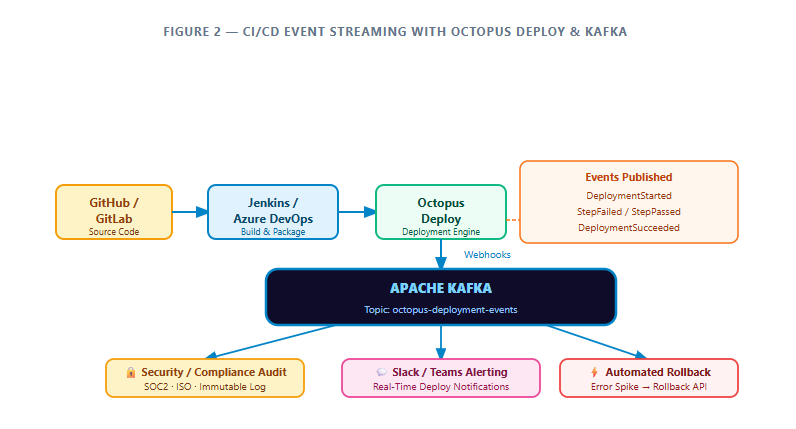
Modern enterprise deployment pipelines generate thousands of operational events. Connecting Kafka to your deployment toolchain turns every release into an observable, auditable, and self-healing event stream.
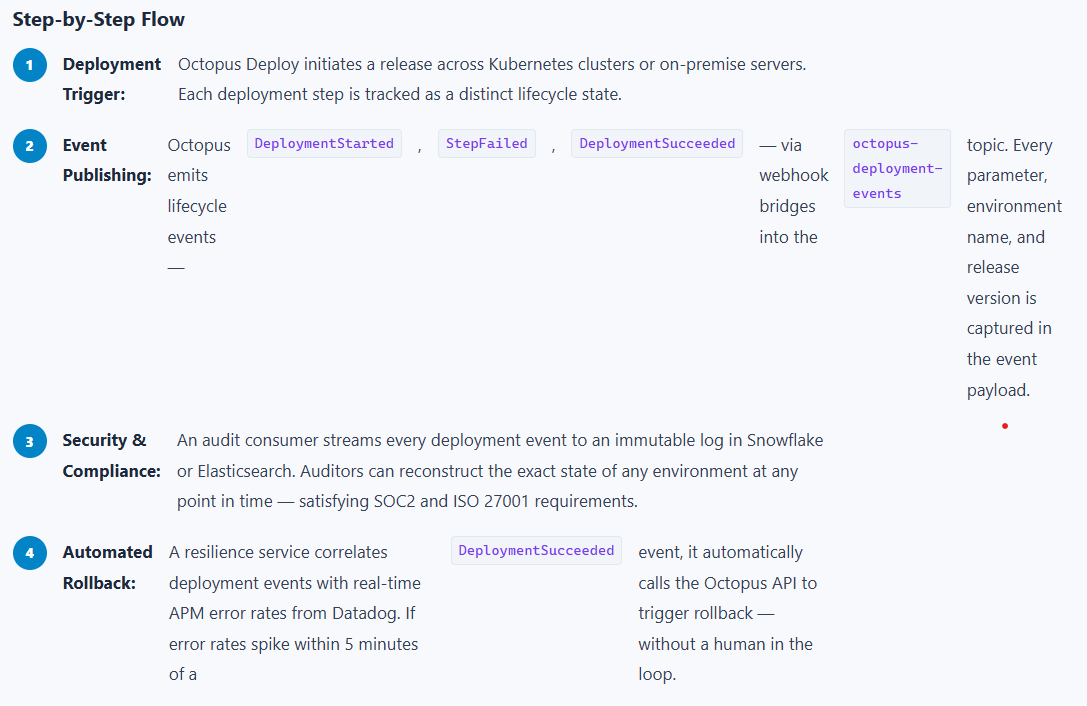
Most teams think of CI/CD as a pipeline that ends when the deployment completes. With Kafka in the loop, it becomes an ongoing event feed — every step, every success, every failure becomes a durable event that downstream systems can act on independently.
The Rollback Pattern
This is the power of event-driven CI/CD. The rollback service doesn’t know about Octopus specifically — it just knows: “if I see a DeploymentSucceeded event and then observe an error rate above threshold in the next 5 minutes, call the rollback endpoint.” That logic is completely decoupled from the deployment tool itself.
Architecture 3: Real-Time AI Inference Broadcasting with Kafka
Traditional AI systems run inference in batch jobs — once every few hours or once a day. Kafka enables a fundamentally different model: stream events to the AI, get predictions back in milliseconds, broadcast those predictions to every consumer that needs them simultaneously.
The key architectural insight is treating Kafka as a two-sided bus for AI. Raw events flow in one direction through a pre-processing layer and into an inference engine. Predictions flow back out through Kafka to every consumer that needs them — fraud alerts, personalization engines, pricing systems, and dashboards — all independent, all in real time.
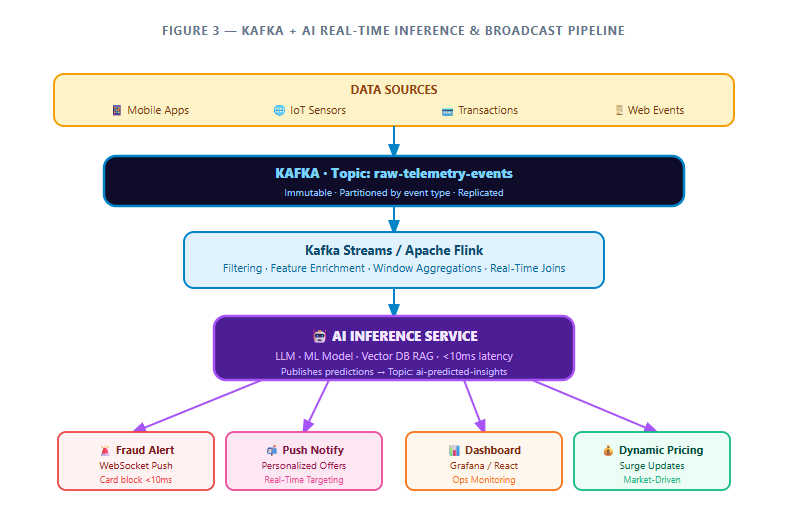
Four AI Patterns This Architecture Enables
1. Real-Time Feature Stores for ML
ML models need clean, contextual features — like a user’s average transaction amount over the last 5 minutes. Kafka Streams aggregates raw events in real time and feeds feature stores (Feast, Redis) with sub-second freshness, replacing daily batch exports.
2. RAG Pipeline Freshness for LLMs
For Generative AI applications, Kafka continuously streams document changes, support ticket updates, and knowledge base edits directly into Vector Databases (Pinecone, Milvus, Qdrant). RAG pipelines retrieve from up-to-date embeddings instead of stale week-old data.
3. Real-Time Fraud Detection
Credit card swipe events route through Kafka. An anomaly detection model evaluates each transaction in under 10ms. Any fraud probability score above 0.90 publishes to ai-predicted-insights, triggering a WebSocket card block before the transaction clears.
4. The AI Broadcast Bus Pattern
The most powerful idea here: the AI inference service publishes one prediction event. Four completely independent consumers act on it simultaneously — fraud alert, push notification, pricing engine, analytics archive. The AI service doesn’t know any of them exist.
Key Insight
In AI systems, the bottleneck is rarely the model — it’s getting clean features to the model fast enough, and distributing predictions to consumers broadly enough. Kafka solves both sides of that problem in one architecture.
What You’ve Seen in Part 2
- How a Swiggy-style food delivery platform uses Kafka to process millions of GPS pings, orders, payments, and notifications in parallel without any service blocking another
- How connecting Octopus Deploy to Kafka turns a CI/CD pipeline into an observable, self-healing, compliance-ready event feed
- How Kafka acts as a two-sided AI bus — routing raw events to inference and broadcasting predictions to a fan-out of independent consumers
Coming Up in Part 3
None of this architecture delivers value without rigorous testing. Part 3 covers the complete Kafka testing strategy — manual testing, automation (unit, integration, contract, performance, chaos), Dead Letter Queues, schema evolution, security testing, and observability validation. Everything beyond just checking if a consumer received a message.