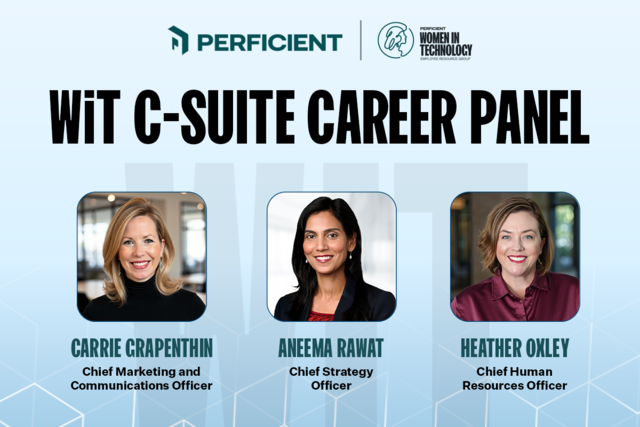
Perficient’s Women in Technology Employee Resource Group recently hosted a candid conversation with three members of the company’s executive leadership team: Carrie Grapenthin, Chief Marketing and Communications Officer; Aneema Rawat, Chief Strategy Officer; and Heather Oxley, Chief Human Resources Officer. The discussion explored leadership, career growth, AI, change management, and the skills professionals need to thrive in an increasingly dynamic environment.
Here are some of the biggest takeaways:
-
Great Careers Rarely Follow a Straight Line
One of the most refreshing parts of the conversation was the panelists’ honesty about how unpredictable career growth can be.
Oxley shared that her path to becoming Chief Human Resources Officer was anything but planned. Beginning her career in technology services delivery, she eventually transitioned into HR after realizing her career needed to better align with her personal goals and family life.
Reflecting on a pivotal career moment, she described returning from maternity leave only to face a reduction in force and having to make a difficult decision about her future. Looking back, she realized she carried the weight of that experience for longer than she needed to.
That experience ultimately shaped how she thinks about leadership and personal branding today, she explained.
Similarly, Rawat described a career fueled less by strategic planning and more by a willingness to see how things work.
“I was driven by [a] curiosity to see how things work,” she said. “It’s been an unconventional career, but that has been driven by the fact that I’m a risk taker.”
-
The Leadership Shift: Stop Solving Every Problem Yourself
One recurring theme was the evolution leaders must make as they advance in their careers.
For Rawat, one of the hardest leadership lessons was learning that success wasn’t about solving every problem herself.
“My role was no longer to fix systems, but to let go of the technical details,” she said. “[To] focus on the big picture, focus on building the culture, the trust, the alignment that actually allows the team to excel.”
It’s a challenge many high performers face. The skills that make individuals successful contributors aren’t always the same skills required to lead teams effectively.
Her advice? Prioritize relentlessly, delegate where appropriate, and focus energy on the few activities that will drive the greatest impact.
“There are always 15 things that you have to address,” she said. “Figure out: These are the three things that I have to get out today.”
-
Mentors Guide. Sponsors Advocate.
One of the most actionable discussions centered on the difference between mentors and sponsors.
Grapenthin emphasized that while mentors and sponsors are both important, they serve different purposes.
“Mentors are offering advice based on their own lived experiences,” she said. “Sponsors, on the other hand, are willing to use their own network and their own reputation to help champion on your behalf.”
She encouraged attendees to think of mentors and sponsors as a “personal board of directors,” a group of trusted advisors who provide different perspectives and challenge your assumptions.
“Everybody in the room has an equal voice,” she explained. “It’s up to you to take all of those inputs in and evaluate which things are most meaningful for you.”
-
Change Isn’t Optional. It’s Necessary.
Rather than viewing organizational change as something to endure, the panelists challenged attendees to broaden their perspective.
One message rang clear: “Change is constant and it’s part of survival in this industry right now.”
Oxley encouraged attendees to zoom out and consider the broader economic, technological, and societal shifts happening around us.
Her perspective was simple but powerful: change isn’t something organizations can avoid. It’s often what enables them to grow and remain relevant.
Rawat shared a similar philosophy rooted in her years living and working in Silicon Valley: “Continuous beta.”
She explained that instead of viewing change as disruption, professionals should view it as a new set of variables to optimize around.
“We have to stop viewing sudden changes as system failures or something to fear,” she said. “We should start viewing them as new parameters to optimize around.”
-
AI Is Accelerating Work, But Humans Still Drive Outcomes
The conversation naturally turned toward AI and its growing influence on the workplace.
The panelists shared practical examples of how they use AI to support writing, research, analysis, presentations, HR processes, and decision-making. Rather than replacing expertise, AI is helping teams move faster and focus on higher-value work.
One insight from Grapenthin stood out: “Content on page is nothing until it comes to life in some sort of business outcome.”
As marketers, strategists, and business leaders generate work more efficiently, the real differentiator becomes execution and impact.
The panelists also emphasized maintaining a human-in-the-loop mindset, ensuring outputs are reviewed, refined, and connected to meaningful business outcomes.
Running Your Own Race
To close the conversation, the panelists reflected on the advice they would give their younger selves.
Rawat’s answer was simple, but powerful.
“Run your own race.”
In an era where comparison is constant and social media makes it easy to focus on what others are doing, her message was a reminder that everyone’s path is different.
“You are a unique individual,” she said. “You were brought onto this planet with a different plan. You have the agency to go set that plan and that course of action.”
Final Thoughts
The conversation reinforced something many professionals need to hear: leadership is not about having all the answers. It’s about staying curious, embracing change, building relationships, learning from setbacks, and continuing to grow.
Perhaps Oxley summarized it best when discussing what future leaders will need most:
“If something’s hard and it’s worth doing, it’s supposed to be hard.”
Whether the topic was career growth, mentorship, AI adoption, or leading through uncertainty, the panel’s message was consistent: meaningful growth rarely happens in comfort zones. Success isn’t defined by a perfect path. It’s defined by how you navigate the challenges, opportunities, and changes along the way.