Introduction
Kubernetes has become the backbone of modern cloud-native applications, enabling organizations to deploy and scale workloads with unprecedented flexibility. However, managing production Kubernetes environments remains a significant challenge for DevOps and Site Reliability Engineering (SRE) teams.
When incidents occur, engineers often spend hours analyzing logs, checking cluster events, reviewing deployment configurations, and executing multiple kubectl commands before identifying the root cause. This traditional troubleshooting approach increases Mean Time To Resolution (MTTR) and impacts business continuity.
To address these challenges, We developed a K8s DevOps AI Agent, an intelligent platform that combines Azure Kubernetes Service (AKS), Azure OpenAI, and an AI-powered orchestration layer to automate Kubernetes troubleshooting, root cause analysis (RCA), and operational guidance.
Why Kubernetes Operations Need AI
Modern Kubernetes environments generate massive amounts of telemetry data, logs, events, metrics, and deployment information. While this data is valuable, it often creates operational complexity.
Some common challenges faced by DevOps teams include:
1. High MTTR During Production Incidents
Engineers must manually correlate pod logs, cluster events, deployment specifications, and node health information. This investigative process can consume valuable time during outages.
2. Diagnostic Fatigue
Production clusters generate enormous volumes of logs and alerts. Identifying the actual issue among thousands of events can be exhausting and error-prone.
3. Command-Line Complexity
Kubernetes troubleshooting often requires extensive knowledge of troubleshooting commands and scripts. Manual execution can slow response times and increase operational risk.
4. Repetitive Remediation Tasks
Many operational issues require repetitive troubleshooting steps that can be automated using intelligent workflows instead of manual intervention
Solution Overview: K8s DevOps AI Agent
The K8s DevOps AI Agent acts as an intelligent operational assistant for Kubernetes environments.
The platform combines:
- Azure Kubernetes Service (AKS)
- Azure OpenAI
- React-based SRE Dashboard
- FastAPI Backend
- AI Agent Orchestration Layer
- Azure Container Registry
- Portkey AI Gateway Integration
Instead of manually investigating incidents, engineers can simply interact with the platform through a natural language chat interface.
For example:
Why pod is failing?
The AI agent automatically gathers logs, pod descriptions, cluster events, and deployment information before generating a structured root cause analysis along with remediation recommendations.
High-Level Architecture
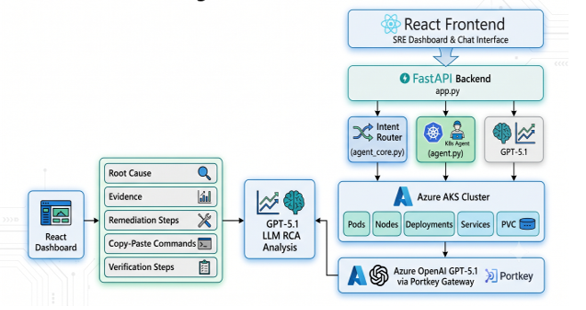
The solution follows a modern cloud-native architecture:
Frontend Layer
A React.js-based SRE Dashboard provides:
- Cluster insights
- Incident analytics
- Chat-based interactions
- AI recommendations
Backend Layer
A FastAPI backend handles:
- API requests
- Agent orchestration
- Kubernetes interactions
- Response generation
AI Agent Layer
The intelligence of the system resides here through:
- Intent Classification
- Log Analysis
- Pod and Node Discovery
- Evidence Collection
- AI-Powered YAML Editing
- Deployment Scaling Operations
- Automated RCA Generation
Kubernetes Layer
The agent continuously interacts with AKS resources including:
- Pods
- Nodes
- Deployments
- Services
- Persistent Volumes
- Cluster Events
AI Layer
Azure OpenAI generates:
- Root Cause Analysis Reports
- Operational Recommendations
- Incident Summaries
- Remediation Guidance
AI-Driven Root Cause Analysis Workflow
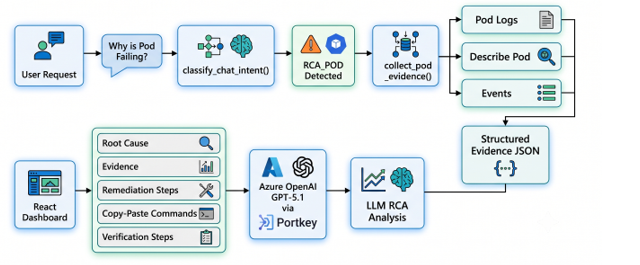
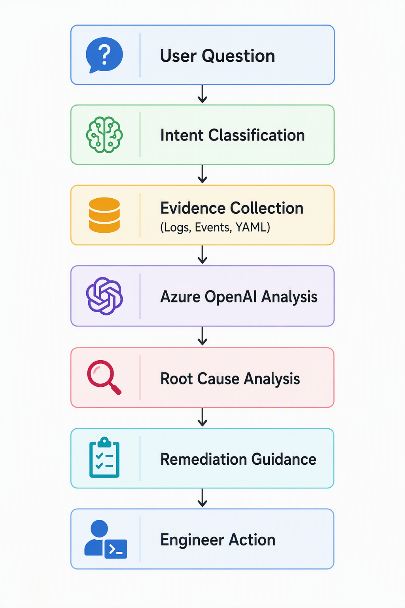
One of the most powerful capabilities of the platform is automated incident investigation. The workflow consists of five simple steps:
- User Incident Query: The engineer submits a natural language question through the chat interface.
- Intent Classification: The AI engine determines whether the query involves pod failures, deployment issues, node problems, scaling operations, or cluster health investigations.
- Evidence Collection: The agent automatically gathers pod logs, cluster events, pod specifications, deployment configurations, and namespace details.
- LLM-Based Analysis: Azure OpenAI processes the collected telemetry and synthesizes findings into a human-readable root cause report.
- Remediation Recommendations: The platform responds with a root cause summary, corrective actions, copy-paste Kubernetes commands, verification steps, and best-practice recommendations.
This entire process takes seconds instead of hours.
SRE Dashboard
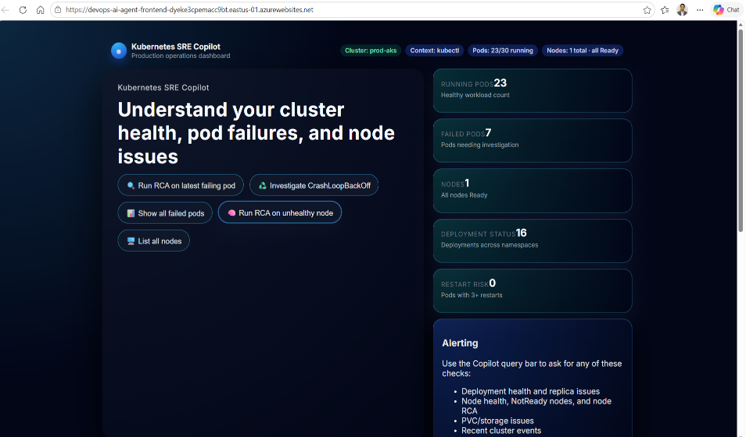
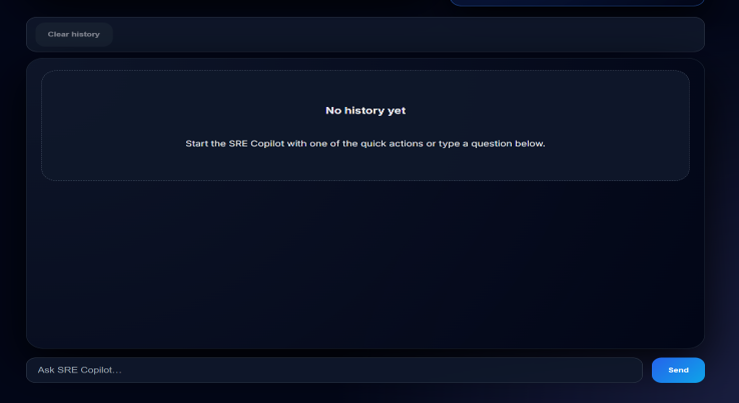
- The React-based dashboard provides a centralized experience for Kubernetes operations, enabling engineers to:
- Monitor cluster health
- View AI-generated RCA reports
- Interact with the AI agent using natural language
- Review incident analytics
- Access recommended remediation actions
Real Incident Example
Consider a production workload experiencing a pending error.
Traditional Troubleshooting
kubectl get pods
kubectl logs pod-name
kubectl describe pod pod-name
kubectl get events
Engineers manually correlate logs, events, and deployment configurations before identifying the root cause.
AI Agent Approach
User:
Why pod is failing?
AI Response & Execution:
This typically reduces troubleshooting effort from hours to seconds.
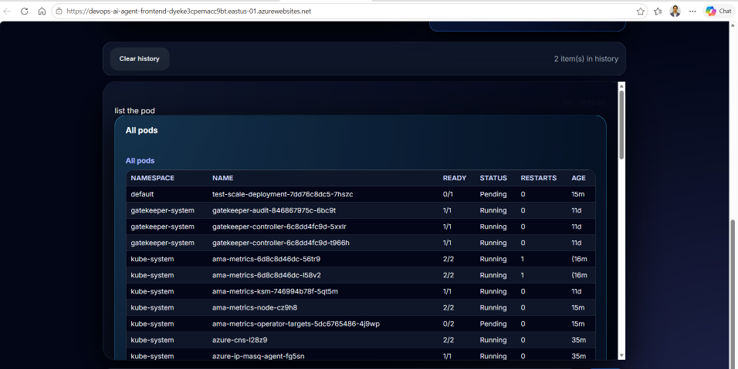
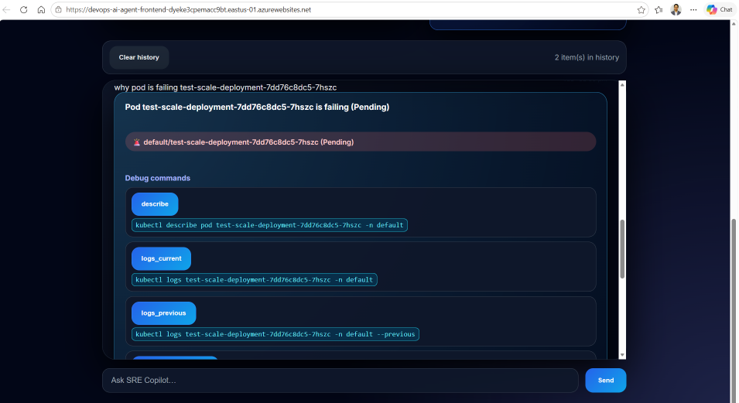
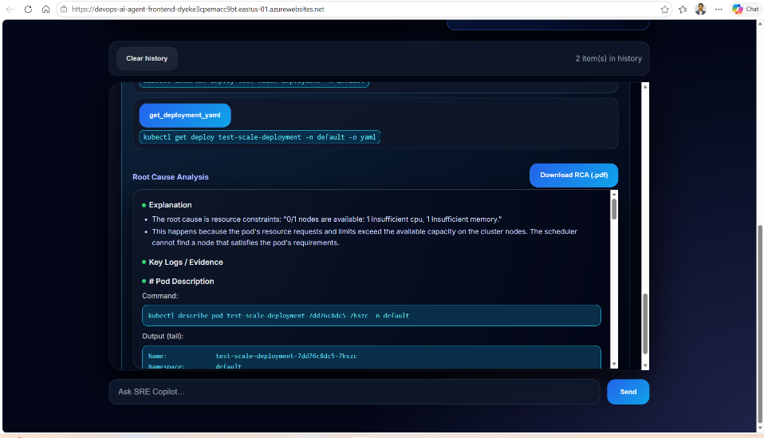
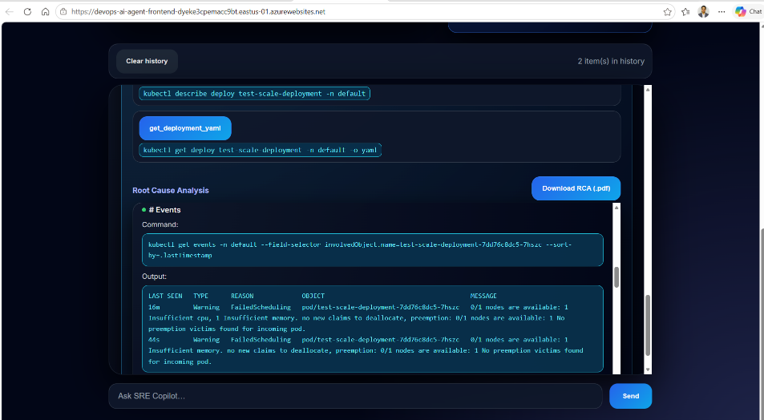
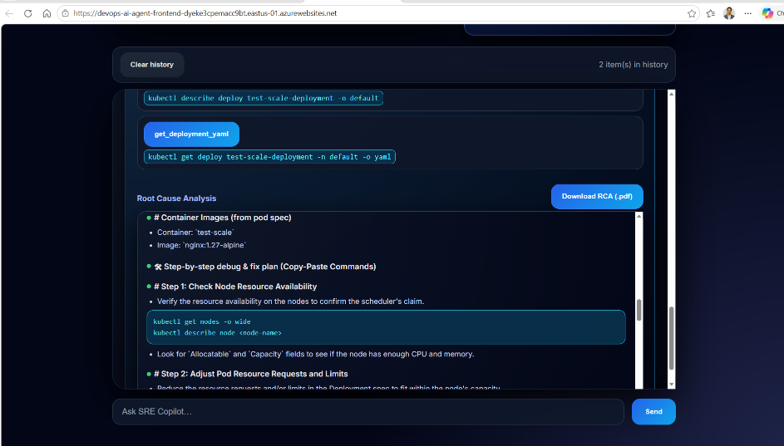
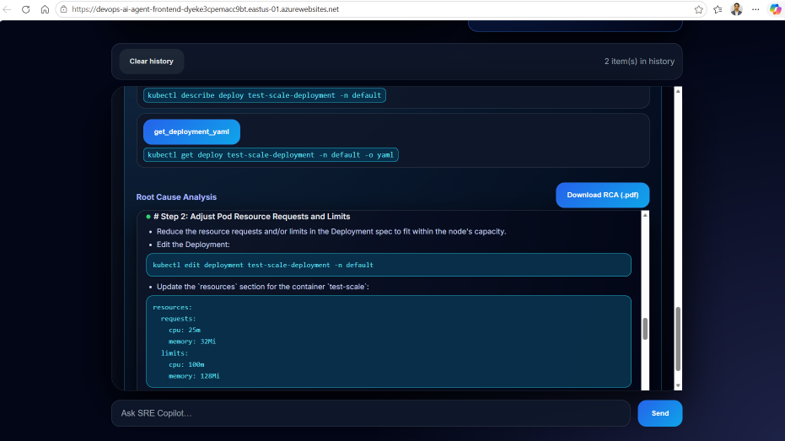
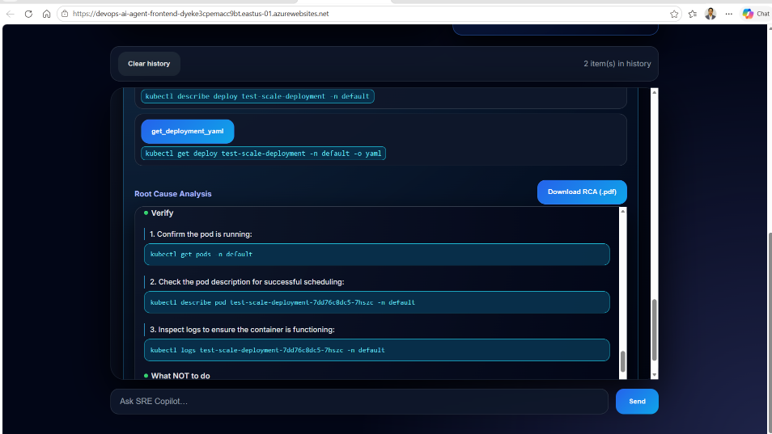
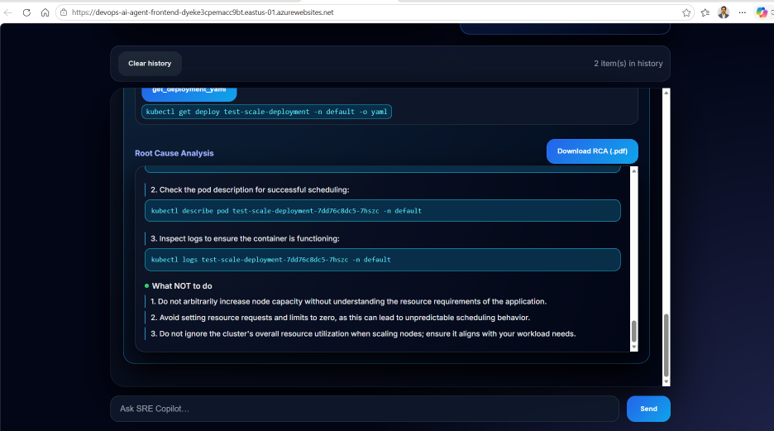
As shown in the dashboard screenshots below, the SRE Copilot immediately identifies the failing pod (test-scale-deployment-7dd76c8dc5-7hszc), pulls cluster evidence, and presents an interactive Root Cause Analysis:
- Root Cause Identified: Resource constraints (0/1 nodes are available: 1 Insufficient cpu, 1 Insufficient memory).
- Evidence Gathered: Automatically executes and outputs results for kubectl describe pod and kubectl get events.
- Actionable Remediation: Generates exact copy-paste kubectl edit deployment commands with recommended CPU/memory requests and limits.
- Verification & Safety: Provides post-fix verification steps and explicit “What NOT to do” safety guidelines to avoid cluster instability.
This automated workflow reduces troubleshooting effort from hours to seconds.
Technical Implementation
The solution is built using a modern technology stack:
| Component | Technology |
| Hosting Platform | Azure App Service |
| Frontend | React.js |
| Backend | FastAPI (Python) |
| Kubernetes | Azure Kubernetes Service (AKS) |
| AI Engine | Azure OpenAI GPT via Portkey |
| Container Management | Azure Container Registry |
The architecture enables scalable, secure, and enterprise-ready AI operations for Kubernetes environments.
AI Safety Guardrails
The AI agent operates within predefined operational boundaries:
- Read-only diagnostics by default
- Controlled access to cluster resources
- Prompt validation and sanitization
- Audit trail for every AI recommendation
- Human approval for remediation actions
These controls ensure recommendations remain transparent, explainable, and secure.
Benefits
Faster Incident Resolution
AI-generated root cause analysis dramatically reduces MTTR by shortening troubleshooting cycles from hours to seconds.
Enhanced Operational Efficiency
SRE teams spend less time analyzing logs and more time improving platform reliability and automation.
Explainable Recommendations
Unlike black-box automation, the AI agent provides evidence-based explanations supported by logs, events, and Kubernetes metadata.
Reduced Downtime
Faster diagnostics lead directly to improved service availability and business continuity.
Improved User Experience
Engineers can interact with Kubernetes using natural language rather than memorizing complex command-line workflows.
Conclusion
AI is rapidly transforming how organizations operate cloud-native platforms. The K8s DevOps AI Agent demonstrates how Azure OpenAI and Kubernetes can work together to simplify operations, accelerate incident response, and improve system reliability.
By combining intelligent root cause analysis, automated evidence collection, and natural language interactions, organizations can significantly reduce operational overhead while empowering engineers to focus on innovation rather than repetitive troubleshooting.
The future of Kubernetes operations is not just automated, it is intelligent.