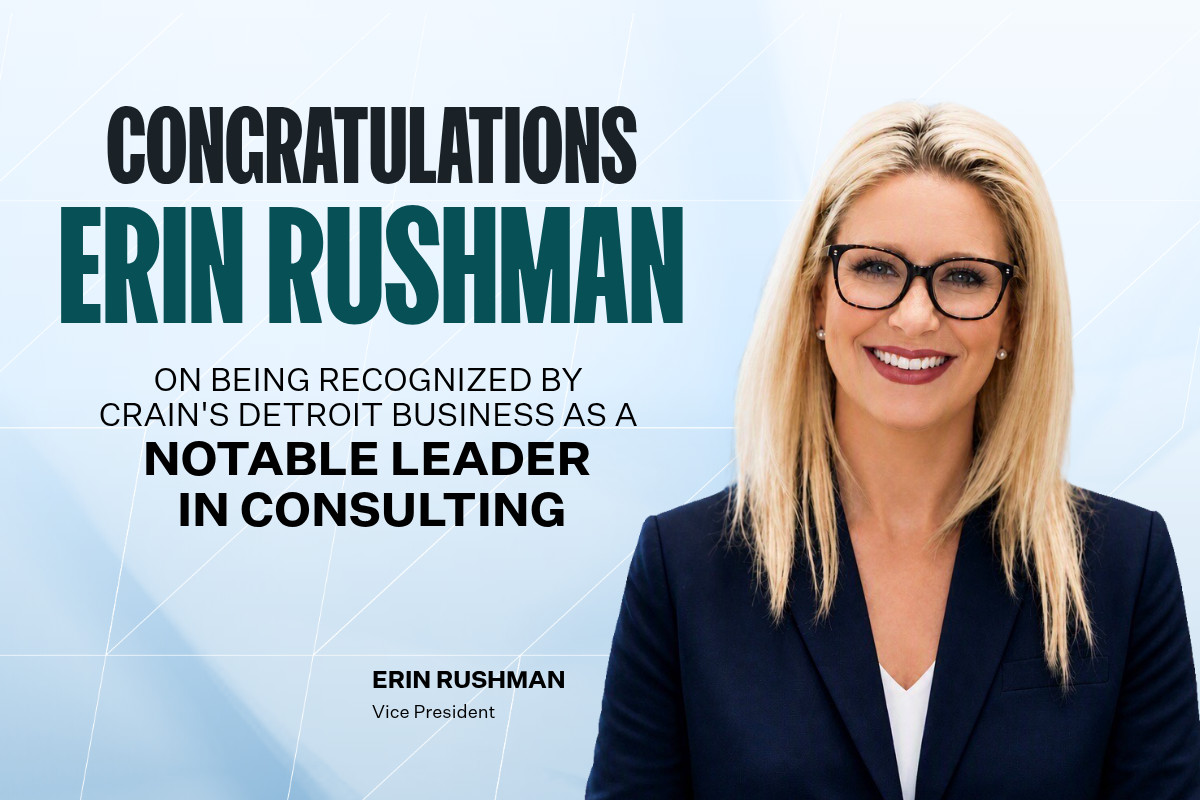
Erin Rushman has been named one of Crain’s Detroit Business’ Notable Leaders in Accounting, Consulting & Law. The honor comes at a pivotal moment. Across industries, organizations are moving beyond AI experimentation and pilot programs and confronting a more difficult question: How do we turn AI investments into meaningful business outcomes?
As Vice President of Strategy, Experience & Automation at Perficient, Erin helps organizations align customer experience, workforce enablement, and technology strategy to realize measurable value from AI and digital investments.
We recently sat down with her to discuss the question she hears most often from clients, how customer expectations are evolving, why organizations are shifting from change management to change enablement, and how AI is changing the way work gets organized and executed.
How Can Organizations Use AI to Make Employees More Productive?
It’s probably the most common AI question I hear from clients.
What’s interesting is that productivity isn’t actually the destination. It’s the starting point.
One of the biggest mistakes organizations make is measuring time saved instead of value created. Leaders naturally want to quantify efficiency gains, but hours saved only matter if they’re reinvested in better decisions, stronger customer experiences, and higher-value work.
The organizations creating the greatest business value aren’t asking how AI can help employees work faster or simply accelerate existing ways of working. They’re asking a different question: How should work change?
AI can accelerate analysis, content creation, and execution. What it cannot do is eliminate uncertainty. The people closest to a business challenge still provide the judgment, context, and interpretation needed to determine whether AI’s outputs create value or create risk.
The organizations pulling ahead aren’t replacing human decision-making. They’re redesigning workflows so people spend less time on routine tasks and more time applying expertise where nuance matters most.
How Is AI Changing Competitive Differentiation and Customer Experience?
Many organizations still think about customer experience through the lens of channels they own: websites, mobile apps, contact centers, and digital platforms.
But customer behavior is changing.
Increasingly, customers are relying on AI-powered assistants and intelligent systems to research products, compare providers, surface recommendations, and complete transactions. In many cases, decisions are being made before a customer ever directly engages with a brand.
That’s why we’re seeing growing interest in agentic customer experience.
In an agentic environment, organizations must think beyond traditional customer journeys and focus on how decisions are made, executed, and governed in real time.
The companies that will win in this next phase aren’t simply creating better digital experiences. They’re combining machine intelligence with business context and governance to ensure decisions remain accurate, explainable, and aligned to customer needs.
To compete in an agentic environment, organizations need foundational capabilities: real-time decisioning, orchestrated workflows, and governed personalization.
Together, these capabilities help organizations remain relevant even when customer interactions happen in environments they don’t control.
At the same time, leaders should be careful not to become overly focused on agents themselves.
Many executive conversations today begin with the question, “How do we implement agentic AI?” The more important question is, “What work are we trying to improve and what business outcomes are we trying to achieve?”
Organizations create value when they align AI, automation, governance, and human expertise to the work being performed. The most successful companies won’t be the ones with the most agents. They’ll be the ones that apply the right mix of technologies, workflows, and human judgment to deliver meaningful impact.
How Do Organizations Turn AI Adoption Into Meaningful Behavior Change?
Historically, change management often focused on helping people adapt to a new process, platform, or organizational initiative.
AI introduces a different challenge. Organizations aren’t simply implementing a new technology. They’re asking employees to rethink how decisions are made, how expertise is applied, and how work is performed.
That’s one reason we’re increasingly using the term change enablement. The shift may seem subtle, but it’s important.
Change management can imply that change is happening to people and we’re helping them cope with it.
Change enablement shifts the focus toward helping people develop the confidence, skills, behaviors, and habits needed to succeed in a new environment.
The biggest barriers aren’t always technical. They often involve trust, uncertainty, behavior, and psychology.
Interestingly, many organizations assume employees are primarily worried about job displacement. In practice, we often see something different. Employees want clarity on how to use AI appropriately, when to trust it, how it’s governed, and how success will be measured.
The organizations that succeed focus just as much on behavioral adoption as they do on technology implementation.
One example involved a large insurance broker implementing AI tools across the organization. Rather than delivering traditional one-time training, the organization invested in a phased enablement program designed to change daily behaviors and work habits. Within three weeks, AI usage increased by 37%, demonstrating the difference between tool deployment and meaningful adoption.
Ultimately, AI delivers value when people change how they work, not when technology gets deployed.
Why Are Operating Models Becoming Critical for AI Success?
Many organizations still view AI primarily as a technology initiative. We challenge leaders to consider it a question of how work gets organized, governed, and executed.
The most important questions are no longer: Which model should we use? Which platform should we implement? Which agent should we build?
Instead, leaders are asking: How should decisions be made? Which work should be performed by humans versus AI? How do we govern human-agent collaboration? Who owns accountability when decisions are automated? And—importantly—how does this work support the business outcomes that matter most?
What’s particularly interesting is that the biggest disruption isn’t occurring at the enterprise level. It’s happening within functions and teams, where leaders are redefining workflows, roles, decision rights, and governance.
Looking ahead, the advantage won’t come from choosing the latest AI platform. It will come from building an organization that can continuously adapt as technology evolves. The leaders making the greatest progress are embedding operational governance, experimentation, and learning directly into how work gets done.
What’s the Biggest Mistake Organizations Are Making With AI?
They’re treating AI as a technology initiative instead of a business strategy.
Organizations that pull ahead view AI as a driver of business value, not simply another technology investment.
Technology matters. But organizations that focus on technology alone often struggle to scale results because customer experience, workforce adoption, and operating model evolution are deeply interconnected.
The next phase of AI won’t be defined by who deploys the most tools. It will be defined by who can most effectively combine technology, human judgment, and organizational adaptability to create measurable business value.
That’s ultimately what separates experimentation from impact and investment from value.
____
Ready to rethink how work gets done in an AI-first world?
Erin and Perficient’s Strategy & Experience experts partner with organizations to redesign customer experiences, enable new ways of working, and evolve operating models for the age of AI. Learn more about our Strategy & Experience capabilities or contact us to discuss your organization’s next step.