For the past few years, enterprise AI strategy has revolved around a simple question: What can AI do?
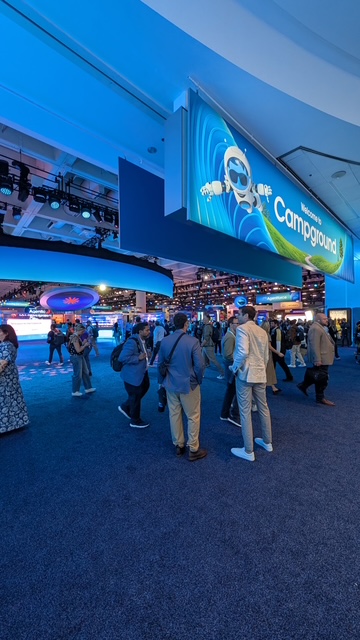
It can summarize customer histories, generate campaigns, prepare sellers for meetings, resolve service requests, and execute increasingly complex sequences of tasks. The more interesting question emerging from Dreamforce is what happens when those capabilities stop living inside isolated pilots and begin operating across the enterprise.
Rather than center Dreamforce on a single breakthrough model or another generation of copilots, Salesforce outlined pieces of a much broader agentic architecture: AIforce as a new interface layer, specialized reasoning through Koa, increasingly autonomous agents, and an enterprise framework intended to govern agents and models across ecosystems.
Taken together, these announcements point to a larger shift:
Enterprise AI is moving from a feature inside software to a layer connecting people, data, decisions, and actions across the business.
The challenge isn’t simply adopting more AI. It’s deciding how applications, interfaces, data, governance, and human judgment should work when AI becomes an active participant in the enterprise.
The Future of Enterprise Software May Be Less About the Interface
One of the biggest ideas shared at Dreamforce was also one of the simplest: What if users don’t have to open an application to benefit from everything behind it?
AIforce is Salesforce’s answer. Positioned above Data 360, Customer 360, and Agentforce, AIforce is intended to make Salesforce data, workflows, and permissions available through the environments where people already operate. Its initial surfaces illustrate the strategy: Claudeforce brings Salesforce into Claude, Slackforce brings Salesforce context to Slack, and Agentforce Coworker provides an AI teammate within Salesforce itself.
Enterprise applications have traditionally asked users to come to them. Users learn the interface, find the right record, navigate the right workflow, and move information from one application to another.
Agentic interfaces potentially reverse that relationship. The system comes to the user, bringing the appropriate data, permissions, and actions with it.
One Model Isn’t Going to Run the Enterprise
Another highlight is an enterprise AI environment where different models perform different jobs.
Koa, Salesforce’s new CRM-specific reasoning model, is one example. Rather than positioning it as a replacement for general purpose models, Salesforce designed Koa for specialized CRM reasoning while models like Claude or ChatGPT can continue handling more general tasks.
This reflects a maturation in enterprise AI strategy.
Early generative AI encouraged organizations to think in terms of model selection: Which model is best? Which provider should become our standard? Which one wins?
The more likely enterprise architecture is heterogeneous. A general-purpose model may be appropriate for one interaction; a domain-specific reasoning model may outperform it for another. Some processes may require deterministic logic alongside probabilistic reasoning. Different cloud environments or data constraints may introduce still more options.
Salesforce’s growing partnerships with Anthropic, AWS, Google Cloud, NVIDIA, and others reinforce that direction.
The strategic advantage may not come from picking a single model. It may come from building an architecture capable of choosing the right intelligence for the right task without forcing the enterprise to rebuild everything around it.
Agents Are Becoming More Specialized and More Autonomous
Dreamforce also revealed another notable change in how Salesforce talks about agents. They increasingly look less like generic AI features and more like specialized digital roles.
Salesforce introduced agents spanning customer service, IT and HR, commerce, supply chain, lead qualification, and outbound sales.
For example, Hunter, Salesforce’s outbound sales agent, is built on what Salesforce describes as a long-horizon runtime. Rather than handling a single interaction and stopping, it’s designed to maintain a goal across days or weeks, use memory, and adjust as circumstances change.
As agents become capable of operating across longer time horizons, leaders will need to define not only what agents can do, but what they should own. Which decisions can they make independently? Which actions require approval? What conditions should trigger human intervention? Who is accountable when an autonomous sequence produces an unexpected result?
The AI Stack is Getting More Complex Just as the Interface Gets Simpler
For the user, AI may make enterprise technology simpler. Ask a question in Claude, Slack, or an AI coworker and let the underlying systems determine what data, model, or agent should respond.
Behind that simplicity, however, the technology environment becomes considerably more complicated.
Organizations may have agents from Salesforce alongside agents from other platforms. Multiple models may reason over the same business context. An agent could call another agent or cross several enterprise systems before completing an action. This makes governance less of a policy exercise and more of an architectural requirement.
Salesforce’s Trusted Enterprise AI Harness reflects this. Its framework brings together context, agency, action, governance, security, and models, supported by an AI Control Plane intended to help organizations discover, register, and monitor agents, including third-party agents.
Organizations have historically governed access primarily around people and applications. An agentic enterprise introduces another participant: nonhuman actors capable of accessing information, making decisions, and taking action.
This requires organizations to rethink identity, permissions, observability, and accountability at the same time they’re expanding AI access. The companies that solve this well won’t simply have stronger guardrails – they’ll have greater freedom to experiment because they’ll understand where their agents are, what they can access, and what they’re doing.
AI Readiness is Really Enterprise Readiness
All of this makes the path from pilot to production more demanding than another round of technology deployment. AIforce can expose business functionality through new interfaces. Specialized models can improve reasoning in targeted contexts. Long-horizon agents can pursue objectives over time. An enterprise AI architecture can govern interactions among them.
An AI-powered interface can’t compensate for customer data employees themselves don’t trust. An autonomous agent can’t reliably execute a process that the organization can’t clearly define. Model orchestration does little good if systems can’t exchange context or actions consistently. And agent governance becomes difficult when permissions were never designed with nonhuman actors in mind.
That’s why adding another AI pilot can create the illusion of progress.
A controlled pilot asks whether a technology can succeed under favorable conditions. Scale exposes everything around the technology that isn’t ready.
Organizations preparing for this next phase should be asking:
- Is the data sufficiently trusted and contextualized for an agent to act on it?
- Can agents carry identity and permissions appropriately across systems?
- Which decisions require human judgment, and which can safely be delegated?
- Can actions move reliably across the applications required to complete an outcome?
- Can the enterprise monitor agents across platforms rather than one ecosystem at a time?
- What happens when an agent fails, encounters ambiguity, or behaves unexpectedly?
- How will users’ responsibilities change as agents take on more persistent roles?
The Real Opportunity Isn’t More AI. It’s a Different Enterprise.
Dreamforce provided plenty of individual technologies to evaluate. AIforce challenges where employees interact with enterprise systems. Claudeforce and Slackforce demonstrate how business context can escape the traditional application interface. Koa points toward a multi-model future. Longer-running agents expand the boundaries of autonomous action. And Salesforce’s emerging governance architecture acknowledges the complexity all of this creates.
Enterprise software itself is being reassembled. The interface is becoming more fluid. Intelligence is becoming more specialized. Agents are becoming more persistent. Platforms are becoming more interoperable. Governance is moving deeper into the architecture.
This should change how leaders approach AI investment.
The next step isn’t to accumulate as many agents, models, or pilots as possible. It’s to decide what kind of enterprise those technologies are entering.
Where should intelligence live? Which systems should remain sources of truth even when users no longer interact with them directly? Which decisions should AI influence versus own? What capabilities need to be shared across every model and agent? And where will human judgment become more important because automation has taken over everything around it?
The first phase of enterprise AI proved that the technology can do remarkable things. The next phase is about building an enterprise that can trust it to do them at scale.