A QA Engineer’s Guide to Testing GenAI Applications
Testing software is no longer enough. In the age of generative AI, quality engineers must learn to test intelligence itself.
Executive Summary
Generative AI is transforming enterprise software at an unprecedented pace.
Organizations are rapidly deploying:
- AI chatbots
- AI-powered search systems
- Document assistants
- Coding copilots
- Autonomous AI agents
Unlike traditional applications, generative AI systems are non-deterministic. The same prompt can produce multiple valid answers.
This introduces new quality challenges, including:
- Response accuracy issues
- Retrieval failures
- Prompt sensitivity
- Agent workflow failures
- Toxicity and bias
- Non-deterministic outputs
To address these challenges, organizations are increasingly turning to three widely adopted platforms for AI testing and evaluation:
| Tool | Primary Focus | Best For |
| DeepEval | LLM Evaluation | Automated AI Testing |
| Ragas | RAG Evaluation | Retrieval Validation |
| LangSmith | Observability & Monitoring | Agent Debugging |
The Evolution of Software Testing
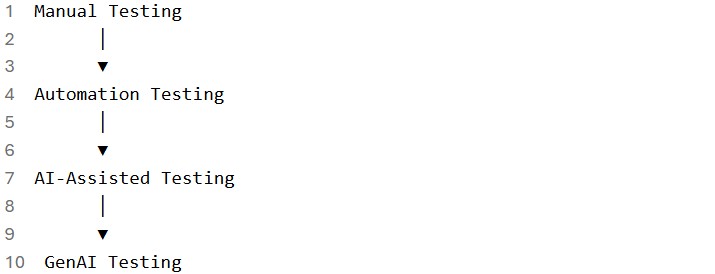
Phase 1: Manual Testing
Focus Areas:
- Functional Validation
- User Acceptance Testing
- Defect Identification
Phase 2: Automation Testing
Popular Tools:
- Selenium
- JUnit
- TestNG
- Playwright
Focus Areas:
- Regression Testing
- CI/CD Integration
- Cross-Browser Validation
Phase 3: AI-Assisted Testing
AI started helping engineers generate:
- Test Cases
- Test Data
- Automation Scripts
Popular Examples:
- GitHub Copilot
- Cursor
- ChatGPT
Phase 4: GenAI Testing
The challenge is no longer generating tests.
The challenge is:
How do we validate AI-generated responses?
This is where evaluation frameworks become essential.
Why Traditional Testing Fails for AI Systems
Traditional Software
Input

Expected Output

Simple and deterministic.
Generative AI System
Question
What are the benefits of opening a savings account?
Response A
| A savings account helps you earn interest while safely storing your money.
Response B
| Savings accounts provide liquidity, security and interest earnings.
- Both responses are correct.
This creates a new testing model:
| Traditional Testing | GenAI Testing |
| Exact Match | Quality Evaluation |
| Pass / Fail | Scored Metrics |
| Assertions | Relevance & Accuracy |
| Deterministic | Probabilistic |
Understanding the GenAI Quality Engineering Stack
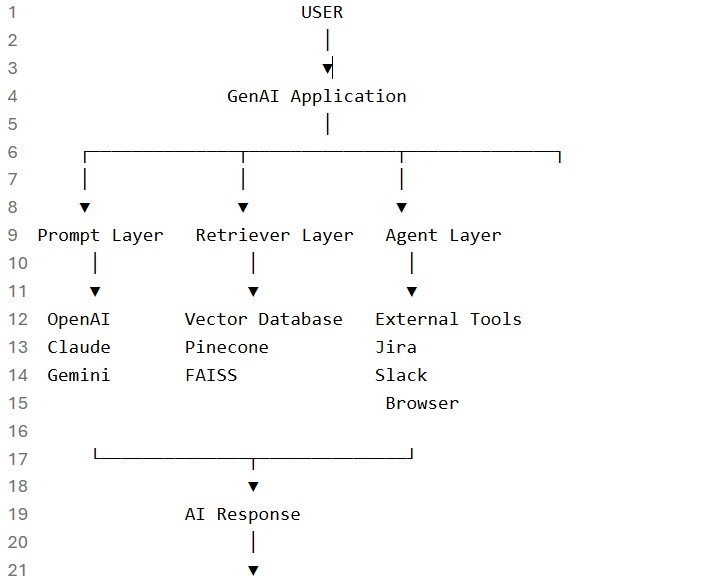

Each platform operates at a different layer of the AI ecosystem.
DeepEval: Bringing Unit Testing to LLM Applications
What is DeepEval?
DeepEval is often called:
“PyTest for LLM Applications”
It allows QA teams to create automated evaluation suites for AI systems.
Core Evaluation Metrics
| Metric | Purpose |
| Answer Relevancy | Does the answer address the question? |
| Faithfulness | Is the answer grounded in context? |
| Hallucination Detection | Is unsupported information generated? |
| Toxicity | Is the output harmful? |
| Bias Detection | Is the response fair and neutral? |
Banking Chatbot Example
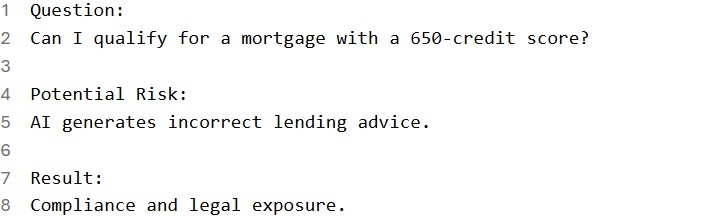
DeepEval helps catch these issues before production.
Strengths
- Excellent Regression Testing
- CI/CD Friendly
- Rich Evaluation Metrics
- Familiar with QA Engineers
Limitations
- Requires Evaluation Datasets
- Limited Production Monitoring
- Basic Observability
Ragas: The Gold Standard for RAG Evaluation
What is RAG?
RAG stands for:
Retrieval-Augmented Generation
Instead of relying solely on model training data, the system retrieves relevant information before generating an answer.
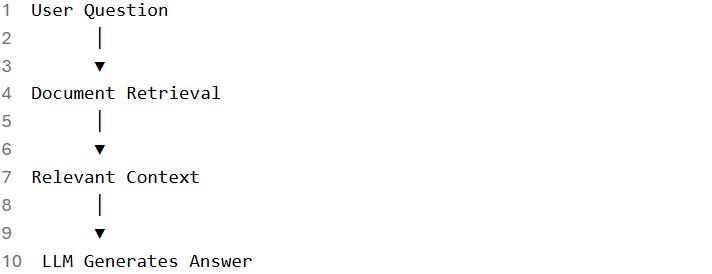
Example
Question:
What is our refund policy?
Retrieved Sources:
- Refund Policy PDF
- Knowledge Base Articles
- Support Documentation
Critical Question:
Did the system retrieve the right information?
This is where Ragas shines.
Core Metrics
| Metric | Purpose |
| Context Precision | How much retrieved content is relevant? |
| Context Recall | Was important content retrieved? |
| Faithfulness | Is response supported by sources? |
| Answer Relevancy | Does the answer solve the question? |
Strengths
- Purpose Built for RAG
- Open Source
- Industry Adoption
- Powerful Retrieval Metrics
Limitations
- Limited Agent Testing
- Minimal Observability
- Mainly RAG-Focused
LangSmith: Observability for AI Systems
Why LangSmith?
Imagine an AI Agent receives this request:
| Create a Jira defect and send a Slack notification.
The agent will:
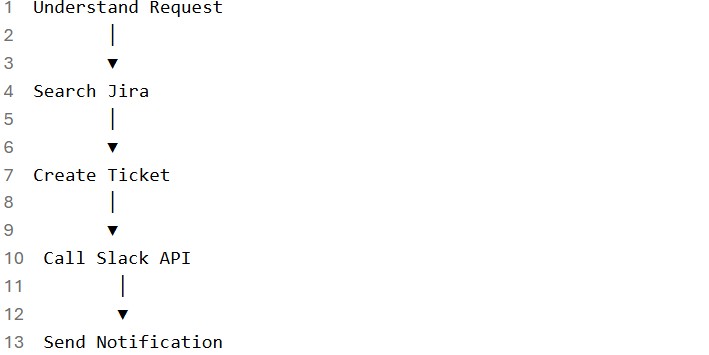
If something fails, identifying the root cause becomes difficult.
LangSmith provides full execution visibility.
What LangSmith Tracks
| Capability | Description |
| Prompt Traces | Every LLM interaction |
| Agent Execution | Decision Flow Tracking |
| Tool Calls | External API Visibility |
| Monitoring | Production Insights |
| Dataset Management | Evaluation Dataset Storage |
Strengths
- Exceptional Observability
- Agent Debugging
- Root Cause Analysis
- Production Monitoring
Limitations
- Fewer Evaluation Metrics
- Advanced Features May Require Paid Plans
Head-to-Head Comparison
| Feature | DeepEval | Ragas | LangSmith |
| LLM Evaluation | ⭐⭐⭐⭐⭐ | ⭐⭐⭐ | ⭐⭐ |
| RAG Evaluation | ⭐⭐⭐ | ⭐⭐⭐⭐⭐ | ⭐⭐ |
| Hallucination Detection | ⭐⭐⭐⭐⭐ | ⭐⭐⭐ | ⭐⭐ |
| Faithfulness | ⭐⭐⭐⭐⭐ | ⭐⭐⭐⭐⭐ | ⭐ |
| Agent Testing | ⭐⭐⭐⭐ | ⭐⭐ | ⭐⭐⭐⭐⭐ |
| Tracing | ⭐⭐ | ⭐ | ⭐⭐⭐⭐⭐ |
| Monitoring | ⭐ | ⭐ | ⭐⭐⭐⭐⭐ |
| QA Friendly | ⭐⭐⭐⭐⭐ | ⭐⭐⭐⭐ | ⭐⭐⭐ |
Which Tool Should QA Teams Choose?
If You’re Testing LLM Applications
> Choose DeepEval
Best for:
- Prompt Regression Testing
- Hallucination Detection
- Automated Quality Validation
If You’re Testing RAG Systems
> Choose Ragas
Best for:
- Retrieval Evaluation
- Knowledge Assistants
- Enterprise Search Solutions
If You’re Testing AI Agents
> Choose LangSmith
Best for:
- Agent Debugging
- Tool Call Visibility
- Production Monitoring
Enterprise Recommendation
The most mature organizations use all three together.
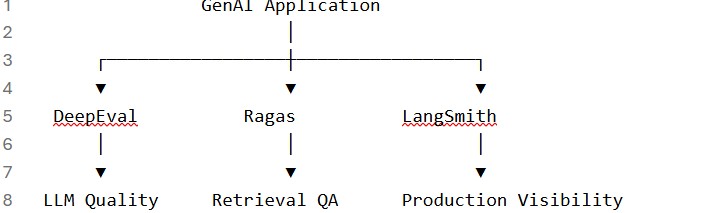
Traditional QA vs GenAI QA
| Traditional QA | GenAI QA |
| Test Cases | Evaluation Datasets |
| Assertions | Evaluation Metrics |
| Regression Suite | Prompt Regression Suite |
| Defects | Hallucinations |
| Application Logs | Agent Traces |
| Test Automation Framework | Evaluation Pipeline |
The Future of AI Testing
Over the next 3 years, we are likely to see:
- Autonomous testing agents
- Continuous LLM evaluation
- Synthetic evaluation dataset generation
- AI governance platforms
- Agent observability frameworks
- Dedicated AI quality engineering teams
The future of testing is moving beyond software validation to intelligence validation.
Recommended Learning Resources
Official Documentation
- DeepEval Documentation: https://deepeval.com/docs
- Ragas Documentation: https://docs.ragas.io/en/latest/
- LangSmith Documentation: https://docs.smith.langchain.com/
YouTube Tutorials (Hands-on Use Cases)
DeepEval
- RAG Evaluation Using DeepEval & Confident AI (Full Tutorial) – https://www.youtube.com/watch?v=402EyLS59ho
- DeepEval Tutorial: Unit Testing LLM AI Applications – https://www.youtube.com/watch?v=ZHiJ12MhfQ8
- Evaluate LLMs in Python with DeepEval – https://www.youtube.com/watch?v=HAoKJT3af7Y
Ragas
- RAG Evaluation Metrics Tutorial using RAGAS – https://www.youtube.com/watch?v=f8zMrSysnjY
- How to Evaluate RAG Models Using RAGAS (Step-by-Step) – https://www.youtube.com/watch?v=ahDqIQb3\_8w
- RAGAS: Evaluate a RAG Application Like a Pro – https://www.youtube.com/watch?v=5fp6e5nhJRk
LangSmith
- Getting Started with LangSmith: Tracing – https://www.youtube.com/watch?v=fA9b4D8IsPQ
- LangSmith Tutorial: Observability and Tracing for AI Agents – https://www.youtube.com/watch?v=EdzAH5\_PppM
- LangSmith + LangChain: Full AI Agent Tracing & Debugging Tutorial – https://www.youtube.com/watch?v=DmEEZ2TiKfY
Final Thoughts
Generative AI introduces a new set of different quality considerations.
Traditional testing frameworks remain important, but they are no longer sufficient on their own:
- DeepEval helps validate LLM quality.
- Ragas ensures retrieval systems work correctly.
- LangSmith provides visibility into complex AI workflows.
For modern QA engineers, understanding these platforms is rapidly becoming a core skill rather than a nice-to-have capability.