
Large Language Models (LLMs) are increasingly being used to power AI applications across industries. As adoption grows, organizations need ways to evaluate output quality, consistency, and relevance.
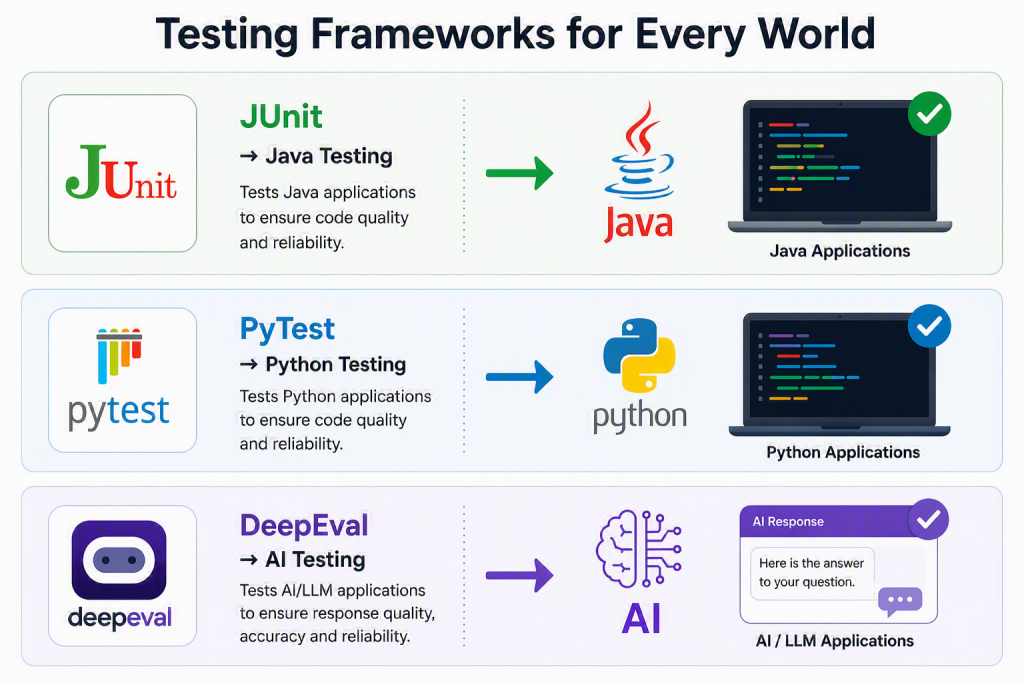
DeepEval is an evaluation framework that tests AI outputs the way software engineers test code.
1. Why Testing Is Required
Traditional software is predictable; LLMs are probabilistic. Responses may vary depending on prompts, context, and available information. DeepEval addresses this through automated test cases, evaluation metrics, benchmarking, and continuous reporting.
2. Types of Test Cases
Single-Turn, Multi-Turn, and Arena Test Cases provide increasing levels of evaluation coverage.
3. End-to-End LLM Evaluations
Treat the application as a black box and evaluate final user outcomes.
4. Confident AI Platform Features
Confident AI extends DeepEval with Test Runs, Datasets, Arena comparisons, Experiments, Prompt Studio, Reporting, Observability, Governance, and collaborative evaluation workflows.
5. Why This Matters for Business
Objective quality measurement reduces risk and increases trust in AI systems.
Conclusion
DeepEval converts subjective AI evaluation into measurable engineering metrics.
6. Evaluation Report Screenshot
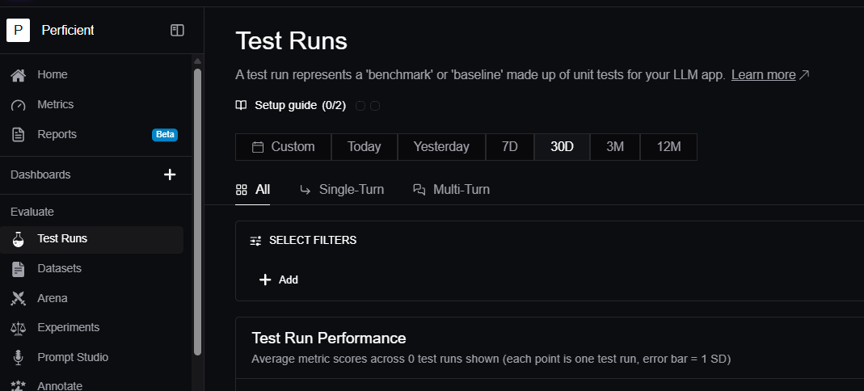
Figure 1. DeepEval / Confident AI Test Runs dashboard.
7. Python Installation
pip install deepeval
pip install –upgrade deepeval
deepeval –help
pip show deepeval – Get the version of deepeval
8. Running DeepEval Locally
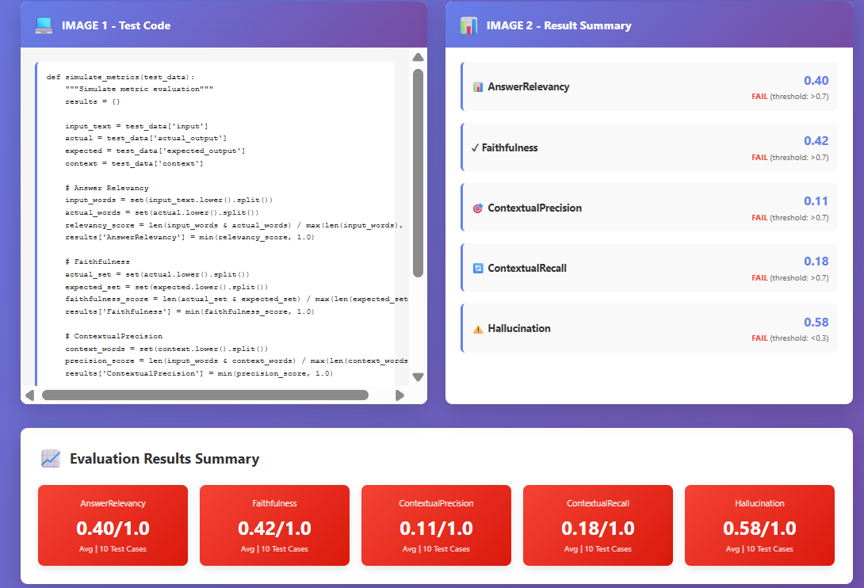
One important observation from my testing:
I successfully performed local DeepEval testing without using an OpenAI API key by executing custom Python-based evaluation logic and creating evaluation reports locally.
This demonstrates that evaluation concepts and reporting can be validated locally using Python implementations. However, DeepEval also supports advanced LLM-as-a-Judge metrics.
Arena Test Case Diagram
Model A Answer —-> Compare —-> Winner
Model B Answer —-^
End-to-End Evaluation Flow
User Query -> AI App -> Response -> DeepEval Metrics -> Report -> Improvement
LLM Evaluation Lifecycle
Datasets -> Test Cases -> Evaluation -> Metrics -> Test Runs -> Optimization
- Test Runs: Benchmark and track evaluation results over time.
- Datasets: Manage golden datasets and evaluation samples.
- Arena: Compare prompts, models, and responses side-by-side.
- Experiments: Measure quality impact before release.
- Prompt Studio: Iterate and validate prompts systematically.
- Reports & Dashboards: Centralized visibility into AI quality.
- Observability: Monitor production traces and quality signals.
- Governance: Standardize evaluation across teams.
References
https://deepeval.com/docs/evaluation-test-cases