by Nick Passero, Director AI Data & Analytics, Databricks Practice Lead
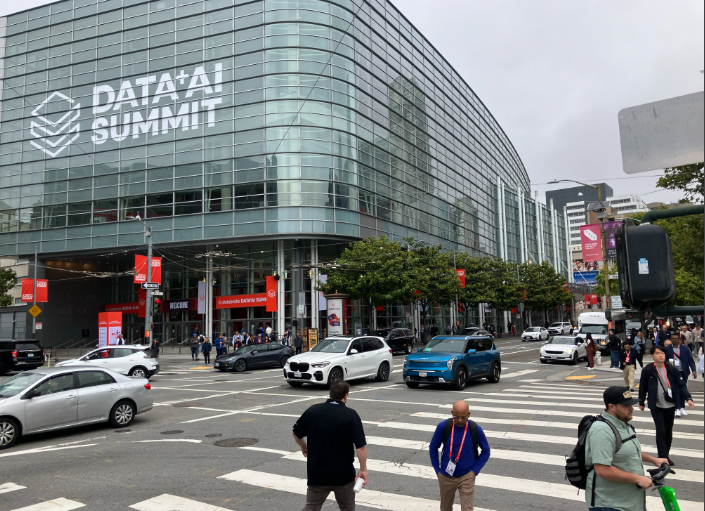
Each year, the Databricks Data + AI Summit sets the agenda for enterprise data and AI. With more than 30,000 attendees at Moscone Center, this year felt different. Not because of any single announcement, but because of what the announcements collectively signal: we’ve crossed a threshold. The conversation is no longer about whether AI is capable. It’s about whether your organization is ready.
Here are my five most important takeaways from DAIS 2026:
1. AGI Is Already Here, But Your Organization Isn’t Ready for It
The most provocative moment of the entire summit came in the opening minutes of CEO Ali Ghodsi’s keynote. His message was unambiguous: AGI is here, and the problem is no longer about intelligence.
This wasn’t entirely surprising. Those of us who follow Ghodsi’s interviews and public commentary have heard him building toward this framing for a while. But hearing it as the opening thesis of a 30,000-person summit, backed by a full product portfolio organized around it, made it land differently.
Databricks organized its entire 2026 product portfolio around four enterprise pain points: context, control, cost, and choice. If AI is already smart enough, the bottleneck is whether your organization can give AI systems the grounding they need to act appropriately on your behalf, within your business, using your data, and according to your rules.
We’ve watched this shift happen live in client engagements. The question stopped being, “Can we build this?” It’s now entirely about trust, grounding, and governance. That reframing should inform every AI investment decision you’re making today.
2. Genie Ontology: The Most Important Foundation Play at DAIS
Genie Ontology is a continuous-learning semantic layer that automatically extracts business meaning from your data estate: tables, queries, dashboards, and pipelines. Rather than forcing analysts and engineers to manually annotate data assets with business definitions, Genie Ontology learns the language of your organization, including your metrics, processes, KPIs, and organizational hierarchy, and makes that knowledge available to every AI agent operating in your environment.
The capability is genuinely compelling. A general-purpose model doesn’t know what “net revenue” means in your organization, which pipeline feeds your forecasting dashboard, or what your data governance team considers a reliable source. Genie Ontology builds that knowledge automatically, and that changes what AI agents can do inside your environment.
But it raises a question worth sitting with. The traditional practice of building an ontology is a human activity. It requires deliberate decisions about what concepts matter, how they relate, and what to leave out. An automated system that learns from how your organization already queries its data is powerful, but it is only as good as the patterns it learns from. If your data estate has inconsistencies or inherited assumptions baked into years of query history, those will come along for the ride.
We lean toward believing the strongest outcomes will come from pairing Genie Ontology’s automated extraction with targeted human curation of the concepts that matter most. That said, we are actively exploring how far the automation can take you before curation becomes necessary, and for which use cases the automated layer may be sufficient on its own. This is one of the more interesting questions coming out of DAIS 2026.
3. Genie One Signals the Arrival of the True AI Coworker, Not Just a Chatbot
Building directly on the context foundation of Genie Ontology, Databricks launched Genie One, and it represents a meaningful evolution beyond what most enterprises have deployed as AI assistants to date.
Genie One is available across web, iOS, Android, Slack, and Microsoft Teams. It goes well beyond question-and-answer interactions: it creates documents, runs scheduled tasks, and takes external actions via Model Context Protocol tools. Think of a business analyst asking a question in Slack, getting a governed answer drawn from the lakehouse, and scheduling a follow-up report, all without opening a BI tool. Alongside Genie One, Databricks also launched Genie Agents, the evolution of Genie Spaces, which can now be shared externally through a new OpenSharing capability.
The broader point for enterprise leaders is this: the distinction between an AI tool and an AI coworker is moving from marketing language to a real architectural distinction. Genie One is not a chatbot bolted onto a data platform. It is a context-aware agent that understands your business data, takes action on your behalf, and operates across the communication channels your employees already use every day.
4. Unity AI Gateway Is the Answer to Agent Sprawl
One of the most underappreciated risks of the agentic AI era is what analysts are already calling agent sprawl: the uncontrolled proliferation of AI models, agents, tools, and workflows independently deployed across an organization without centralized oversight.
Most organizations we are talking to right now have multiple AI initiatives running in parallel with no shared cost visibility, no unified audit trail, and no way to enforce policy across them. Each team did the right thing locally. The problem is organizational, not technical. Nobody planned for the inventory.
Databricks’ answer is Unity AI Gateway, which extends the proven Unity Catalog governance model into the runtime layer of AI workloads. It provides centralized controls for governance, observability, budgeting, model routing, and security across an organization’s entire AI estate, including tools, MCP services, skills, traces, cost, and runtime behavior.
For technology and risk leaders, the message is clear: start building your AI governance architecture now, before the agent inventory becomes too large to manage.
5. The Lakehouse Gets Real-Time: LTAP, Lakehouse//RT, and Agentic Data Engineering
Every enterprise running real-time use cases today is paying a tax: a separate serving layer, a synchronization pipeline, a second governance model. The promise of collapsing all of that into a single platform is not a new idea. Many technologies have tried it. Most have not gotten it right.
Databricks is taking a serious run at it. The centerpiece announcement was LTAP (Lake Transactional/Analytical Processing), a new architecture that unifies OLTP and OLAP on a single copy of data using open formats. The practical foundation is Lakebase, Databricks’ new serverless Postgres offering, which puts operational data inside the lakehouse boundary rather than alongside it. Paired with this is Lakehouse//RT, powered by Reyden, a ground-up compute engine rewrite built for the concurrency and latency demands of real-time analytics.
We have been testing Reyden already. In our own work with a healthcare client running FHIR data at scale, we saw sub-100 millisecond patient-specific lookups across billions of records on a small cluster, without a separate serving layer or a second copy of PHI. The results were compelling enough that we wrote about it in depth. If you want the technical detail, you can read more here.
Of all the announcements at DAIS 2026, this is consistently the one our clients are most excited about. The question is not whether the architecture is interesting. It is whether Databricks can deliver on it at enterprise scale across diverse workload types. We are in the field testing it, and we are excited to see where it goes.
What This Means for Your Organization
DAIS 2026 painted a coherent and compelling picture of where enterprise data and AI are heading. Databricks is positioning itself as the open foundation for the agentic enterprise: context through Genie Ontology, governance through Unity AI Gateway, real-time infrastructure through Lakehouse//RT and Reyden, and an AI coworker layer through Genie One.
At Perficient, our Databricks practice is already working with clients to translate these announcements into actionable roadmaps. Whether you are in the early stages of evaluating the Databricks platform or are a mature Databricks customer looking to accelerate your agentic AI capabilities, the conversation to have right now is where these investments fit within your data and AI strategy.