
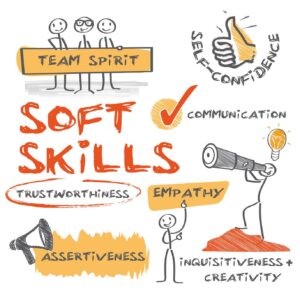
The shift: From “can you code it?” to “can you ship it with people?”
A decade ago, many tech roles were evaluated primarily on hard skills: programming languages, frameworks, systems design, and certifications. Those still matter. But the half‑life of technical skills keeps shrinking, while projects increasingly span cross‑functional teams (engineering, product, design, data, security, operations, legal). In that environment, the people who consistently ship outcomes aren’t just great coders—they’re great communicators, collaborators, and problem solvers.
Three macro forces are driving this:
- AI is changing the task mix, not the need for human judgment. As generative AI scales in the workplace, leaders see opportunity but also a gap: organizations need people who can frame problems, ask better questions, check outputs, and align stakeholders. In 2024, Microsoft & LinkedIn found 75% of knowledge workers already use AI at work, yet the bottleneck is applying AI to business impact—where communication, context‑setting, and collaboration become critical.
- Skills churn is real—and human skills travel. The World Economic Forum projects that 44% of workers’ core skills will change by 2027; analytical and creative thinking top the most in‑demand list, alongside resilience, leadership, and social influence—skills that help teams navigate disruption.
- Leaders expect a surge in upskilling, with human skills center stage. A 2024 Gartner survey reports 85% of business leaders expect skills development needs to surge due to AI and digital trends—pressing L&D to build more agile, outcome‑driven learning that blends technical and human capabilities.
What the data says: The rise of “durable” skills
- WEF Future of Jobs (2023): Analytical thinking ranks #1; creative thinking #2; and multiple “self‑efficacy” skills (resilience, curiosity, lifelong learning) enter the top tier. These are broadly “soft” skills that enable problem framing, adaptation, and collaboration—exactly what AI can’t easily automate.
- 2024 Work Trend Index (Microsoft & LinkedIn): AI adoption is widespread, but the advantage goes to those who can combine AI aptitude with communication and stakeholder alignment to move from experiments to business transformation.
- Harvard / HBS & DCE: Research summaries emphasize that foundational (soft) skills—communication, collaboration, critical thinking—predict faster learning, better wages, and career resilience across 70M job transitions; tech leaders specifically must master clear communication to bridge tech and business.
- Gartner: With skill requirements changing and many IT workforces unprepared for future needs, the differentiator is a culture of continuous learning and the “essential skills” that translate strategy into execution—stakeholder management, collaboration, problem‑solving, and change leadership.
- LinkedIn Learning & Economic Graph: Learning demand skews toward AI literacy and human skills like conflict mitigation, adaptability, and stakeholder management—essential for coordinating across functions and resolving ambiguity.
Why soft skills matter more in tech—right now
1) AI raises the floor on execution, but humans still set the direction
Copilots can draft code, summarize meetings, and generate tests. But someone has to define the problem, set constraints, negotiate trade‑offs, and evaluate risks. That requires structured thinking, clear writing, and facilitation skills. The 2024 Work Trend Index shows AI users save time and focus better, yet moving from individual productivity to enterprise value hinges on leaders and contributors who can align stakeholders and communicate the “why.”
Career implication: The developers who thrive are those who can scope work, write crisp design docs, lead RFCs, and guide cross‑team decisions—because the value has shifted from lines of code to clarity plus coordination.
2) Projects are more cross‑functional—and success lives (or dies) in the seams
Modern initiatives—cloud migrations, data platforms, AI pilots, zero‑trust rollouts—cross multiple domains. Friction often arises not from technical impossibility, but from misaligned expectations and communication gaps. Harvard DCE highlights communication as a top skill for tech leaders: translating complex ideas, influencing non‑technical stakeholders, and practicing active listening to surface risks early.
Career implication: If you can facilitate, negotiate trade‑offs, and co‑create with product, security, finance, and legal, you become the person who keeps critical paths unblocked.
3) The faster skills change, the more foundations matter
When frameworks turn over and platforms evolve, the people who learn fastest and adapt best pull ahead. Large‑scale analyses show that broad, foundational skills (e.g., reading comprehension, teamwork, problem‑solving) enable quicker acquisition of new technical skills and better long‑term mobility—even more than a narrow stack expertise.
Career implication: Investing in problem‑solving, structured communication, and meta‑learning pays dividends across every new language, tool, or cloud service you’ll adopt over the next decade.
4) Organizations need agility—agility is a human capability
Gartner notes executives expect an AI‑driven surge in skills needs and urge agile learning to connect learning with earning (business outcomes). That means teams capable of sense‑making, experimentation, retrospectives, and continuous improvement—all powered by psychological safety and facilitation, not by syntax mastery.
Career implication: Practitioners who can run effective stand‑ups, lead blameless postmortems, and tell the story of impact secure trust—and the next big mandate.
The essential soft skills for today’s tech roles
1) Communication (written & verbal)
- Why it matters: Clear docs reduce rework, align stakeholders, and accelerate decision cycles. In busy, hybrid teams, asynchronous clarity is gold. Harvard DCE calls out active listening, translating complex tech to business value, and persuasive storytelling as core for tech leaders.
- How to build:
- Write one‑page proposals with Purpose → Context → Options → Recommendation → Risks.
- Use structured frameworks (Pyramid Principle, SCQA) for emails and updates.
- Practice “teach‑backs” after meetings to ensure shared understanding.
2) Collaboration & stakeholder management
- Why it matters: Cross‑functional execution is now the norm; LinkedIn’s skill signals highlight stakeholder management and conflict mitigation rising in demand.
- How to build:
- Map stakeholders by interest vs. influence; schedule purposeful 1:1s early.
- Use decision frameworks (RACI, DACI) to prevent ownership ambiguity.
- Facilitate meetings: clear agendas, timeboxing, decision logs.
3) Problem‑solving & analytical thinking
- Why it matters: WEF ranks analytical thinking as the #1 core skill; it’s the backbone for debugging, incident response, and product trade‑offs under uncertainty.
- How to build:
- Practice “five whys,” fault tree analysis, and pre‑mortems.
- Convert vague asks into falsifiable hypotheses and measurable success criteria.
4) Adaptability & resilience
- Why it matters: With 44% of core skills changing by 2027, adaptability is a career moat. Agile learning cultures also correlate with better business outcomes.
- How to build:
- Run quarterly skills sprints—pick one skill, create a 30‑day plan, share learnings.
- Maintain a personal “sunset list” (skills to phase out) and “explore list” (skills to sample).
5) Ethical reasoning & judgment
- Why it matters: As AI and data become pervasive, teams face choices around privacy, bias, and acceptable use. Ethical skills and leadership & social influence appear in the WEF’s skills outlook and are central to trust.
- How to build:
- Use ethics checklists in design reviews; adopt model cards/data sheets; escalate edge cases.
Practical ways to strengthen soft skills (without pausing your sprint)
- Adopt “Docs‑First” Habits
Before building, write a 1–2 page PR/FAQ or design brief. Review asynchronously; capture objections and decisions. This compounds your communication muscle and reduces rework later. - Run Better Meetings
Every session needs an agenda, owner, desired outcome, and timebox. End with a decision log and owners. You’ll save hours weekly and improve team morale. - Shadow & Reverse‑Mentor
Pair senior ICs with PMs or architects to shadow stakeholder calls; invite juniors to “teach back” a topic monthly. It builds empathy in both directions and accelerates growth. - Practice Structured Thinking Daily
Use templates for status updates (Risks, Decisions, Blockers, Next Steps). Over‑communicate what changed and why—especially in hybrid settings. - Close the Loop
After an incident, send an executive‑friendly summary (impact, root cause, fix, prevention). This is stakeholder management in action. - Invest in Targeted Learning
Blend AI literacy with human skills. LinkedIn Learning and Work Trend Index resources show rising demand for conflict mitigation, adaptability, stakeholder management, and AI aptitude.
Measuring soft skills (so they don’t become “nice to have”)
- Communication quality: % of proposals approved without rework; PRD/design doc review cycles.
- Collaboration: Cross‑team cycle time for dependencies; stakeholder NPS after milestones.
- Decision velocity: Time from options presented → decision made; % decisions with clear owner and success metric.
- Learning agility: Quarterly skill goals achieved; internal mobility; participation in postmortems and knowledge shares.
Gartner recommends connecting learning to earning—tie soft‑skills outcomes directly to business metrics (e.g., faster lead time, fewer rollbacks, reduced incident MTTR).
The bottom line
Tech keeps moving faster. Tools come and go. But soft skills—your ability to communicate, collaborate, adapt, and lead—compound over time. That’s why global benchmarks (WEF, Microsoft/LinkedIn, Gartner, Harvard) all converge: the more AI pervades our workflows, the more human the differentiators become. If you’re a technologist aiming for impact—architect, principal engineer, product‑minded developer, or consultant—prioritize building these “durable” skills alongside your stack. They will make every line of code you write more valuable to the business and every project you touch more likely to ship.